N3.8. If a packet's 1 st and 2nd fragments have already arrived, but
the 3rd fragment never comes, the OS will deliver the 1st and
2nd fragments to the upper layer (transport layer). Is this true
of false? Please explain.
N3.10. Please create two packets to emulate the Ping-of-Death attack. Please write Python code.
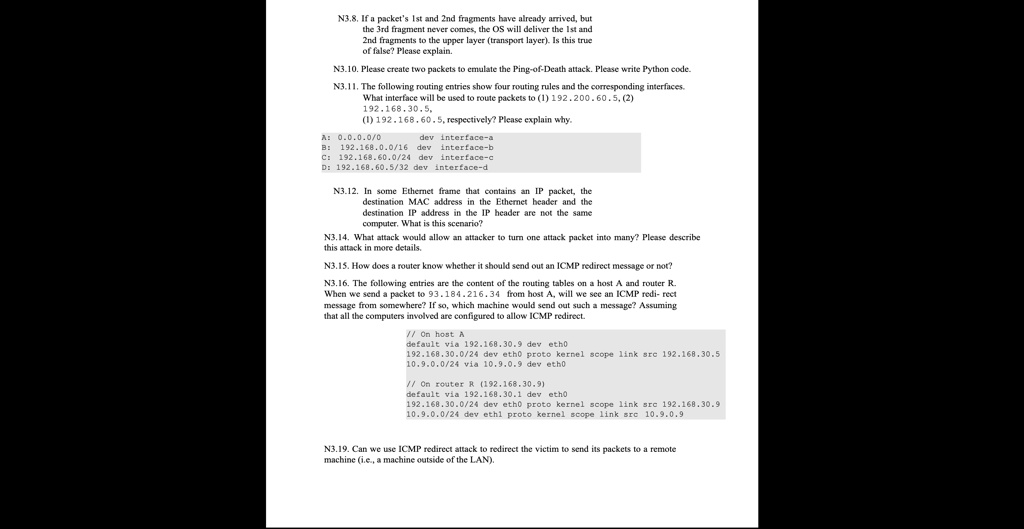
N3.11. The following routing entries show four routing rules and the corresponding interfaces.
What interface will be used to route packets to (1) 192.200 .60 .5 , (2)
192.168 .30 .5 ,
(1) 192.168 .60 .5 , respectively? Please explain why.
A: 0*0*0*(0)/(0) dev interface-a
B: 192*168*0*(0)/(16) dev interface-b
C: 192*168*60*(0)/(24) dev interface-c
D: 192*168*60*(5)/(32) dev interface-d
N3.12. In some Ethernet frame that contains an IP packet, the
destination MAC address in the Ethernet header and the
destination IP address in the IP header are not the same
computer. What is this scenario?
N3.14. What attack would allow an attacker to turn one attack packet into many? Please describe
this attack in more details.
N3.15. How does a router know whether it should send out an ICMP redirect message or not?
N3.16. The following entries are the content of the routing tables on a host A and router R.
When we send a packet to 93.184 .216 .34 from host A, will we see an ICMP redi- rect
message from somewhere? If so, which machine would send out such a message? Assuming
that all the computers involved are configured to allow ICMP redirect.
// On host A
default via 192.168 .30 .9 dev eth0
192.168.30.0/24 dev eth0 proto kernel scope link src 192.168.30.5
10.9.0.0/24 via 10.9 .0 .9 dev eth0
// On router R(192.168.30.9)
default via 192.168.30.1 dev eth0
192.168.30.0/24 dev eth0 proto kernel scope link src 192.168.30.9
10.9.0.0/24 dev eth1 proto kernel scope link src 10.9.0.9
N3.19. Can we use ICMP redirect attack to redirect the victim to send its packets to a remote
machine (i.e., a machine outside of the LAN).
N3.8. If a packet's 1st and 2nd fragments have already arrived, but the 3rd fragment never comes, the OS will deliver the 1st and 2nd fragments to the upper layer (transport layer). Is this true of false? Please explain.
N3.10. Please create two packets to emulate the Ping-of-Death attack. Please write Python code. N3.11. The following routing entries show four routing rules and the corresponding interfaces. What interface will be used to route packets to (1) 1 92 . 200 . 60 . 5, (2) 192.168.30.5, (1) 1 92 . 168 , 60 . 5, respectively? Please explain why. A: 0.0.0.0/0 dev interface-a dev interface-b C: 192.168.60.0/24 dev interface-c D: 192.168.60.5/32 dev interface-d
N3.12. In some Ethernet frame that contains an IP packet, the destination MAC address in the Ethernet header and the destination IP address in the IP header are not the same computer. What is this scenario? N3.14. What attack would allow an attacker to turn one attack packet into many? Please describe this attack in more details.
N3.15. How does a router know whether it should send out an ICMP redirect message or not?
N3.16. The following entries are the content of the routing tables on a host A and router R When we send a packet to 93 . 184 . 216 . 34 from host A, will we see an ICMP redi- rect message from somewhere? If so, which machine would send out such a message? Assuming that all the computers involved are configured to allow ICMP redirect.
77 0n host A default via 192.168.30.9 dev eth0
10.9.0.0/24 via 10.9.0.9 dev eth0
// 0n router R (192.168.30.9) default via l92.168.30.1 dev eth0 i92.168.30.0/24 dev eth0 proto kernel scope link src 192.168.30.9 i0.9.0.0/24 dev ethi proto kernel scope link src 10.9.0.9
N3.19. Can we use ICMP redirect attack to redirect the victim to send its packets to a remote machine (i.e., a machine outside of the LAN)