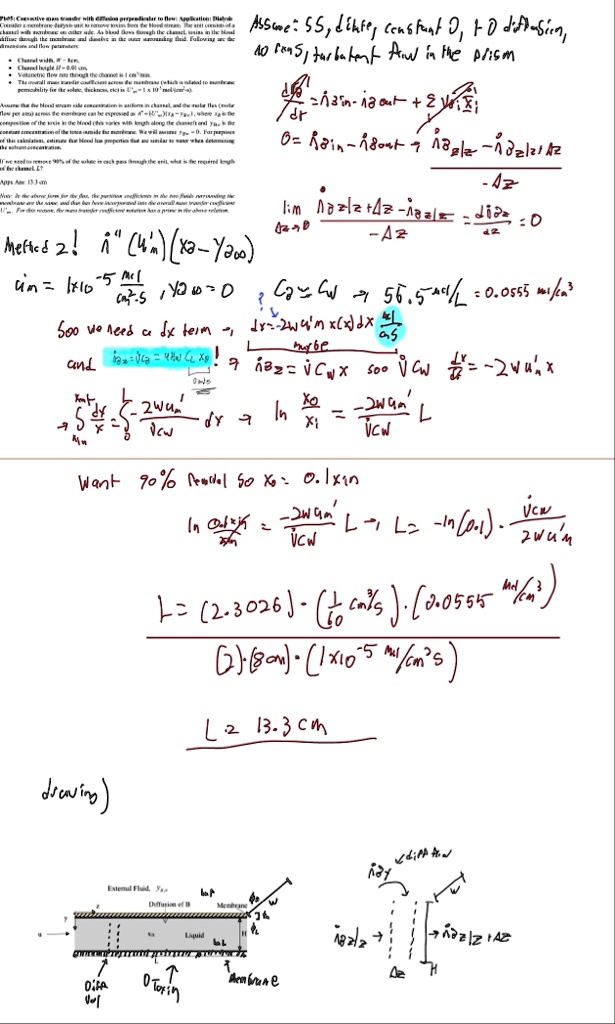
Plot: Convective mass transfer with diffusion perpendicular to flow. Application: Dialysis
Assume a membrane dialysis unit to remove toxins from the bloodstream. The unit consists of a
channel with membrane on either side. As blood flows through the channel, toxins in the blood
diffuse through the membrane and dissolve in the outer surrounding fluid. Following are the
dimensions and flow parameters:
* Channel width $W = 8 \text{cm}$.
* Channel height $H = 0.01 \text{cm}$.
* Volumetric flow rate through the channel is $1 \text{cm}^3/\text{min}$.
* The overall mass transfer coefficient across the membrane (which is related to membrane
permeability for the solute, thickness, etc.) is $U_m = 1 \times 10^{-5} \text{mol}/(\text{cm}^2 \cdot \text{s})$.
Assume that the blood stream side concentration is uniform in channel, and the molar flux (molar
flow per area) across the membrane can be expressed as $N_A = U_m (C_A - C_{A,out})$, where $C_A$ is the
concentration of the toxin in the blood (this varies with length along the channel) and $C_{A,out}$ is the
constant concentration of the toxin outside the membrane. We will assume $C_{A,out} = 0$. For purposes
of this calculation, estimate that blood has properties that are similar to water when determining
the solvent concentration.
If we need to remove $90\%$ of the solute in each pass through the unit, what is the required length
of the channel, $L$?
Apps An: 13.3cm
Note: In the above form for the flux, the partition coefficients in the two fluids surrounding the
membrane are the same, and thus been incorporated into the overall mass transfer coefficient
$U_m$. For this reason, the mass transfer coefficient notation has a prime in the above relation.
Assume: SS, dilute, constant D, 1D diffusion,
no $\text{Re}_y$, turbulent flow in the prism
$\frac{d\dot{N}_B}{dt} = \dot{N}_{B,in} - \dot{N}_{B,out} + \sum \dot{V}_i \dot{X}_i$
$0 = \dot{N}_{B,in} - \dot{N}_{B,out} + \dot{N}_{B,z} - \dot{N}_{B,z+\Delta z}$
$\lim_{\Delta z \to 0} \frac{\dot{N}_{B,z+\Delta z} - \dot{N}_{B,z}}{-\Delta z} = \frac{d\dot{N}_B}{dz} = 0$
Method 2! $\dot{N}'' (U_m') (X_B - Y_{B\infty})$
$U_m = 1 \times 10^{-5} \frac{\text{mol}}{\text{cm}^2 \cdot \text{s}}$, $Y_{B\infty} = 0$
$\dot{C}_B \approx C_W \to 56.5 \frac{\text{mol}}{\text{L}} = 0.0555 \frac{\text{mol}}{\text{cm}^3}$
So we need a $dx$ term $\to d\dot{r} = -2W U_m' x(x) dx \frac{\text{mol}}{\text{cm}^2 \cdot \text{s}}$
and $\dot{N}_{B,z} = \dot{V} C_B X_B$
$\dot{N}_{B,z} = \dot{V} C_W X$ so $\dot{V} C_W \frac{dX}{dt} = -2W U_m' X$
$\int_{X_{in}}^{X_{out}} \frac{dX}{X} = \int_0^L \frac{-2W U_m'}{\dot{V} C_W} dr \to \ln \frac{X_{out}}{X_{in}} = \frac{-2W U_m'}{\dot{V} C_W} L$
Want $90\%$ removal so $X_{out} = 0.1 X_{in}$
$\ln \frac{X_{out}}{X_{in}} = \frac{-2W U_m'}{\dot{V} C_W} L \to L = -\ln(0.1) \cdot \frac{\dot{V} C_W}{2W U_m'}$
$L = (2.3026) \cdot \frac{(1 \text{cm}^3/\text{s}) \cdot (0.0555 \text{mol}/\text{cm}^3)}{(2) \cdot (8 \text{cm}) \cdot (1 \times 10^{-5} \text{mol}/(\text{cm}^2 \cdot \text{s}))}$
$L = 13.3 \text{cm}$
(drawing)
External Fluid, $Y_{B\infty}$
Diffusion of B
Liquid
Membrane
$\dot{N}_{B,z}$
$\dot{N}_{B,z+\Delta z}$
$\Delta z$
H