Texts: Help with questions 4-10
CHM13OL experiment, you will collect and record your observations.
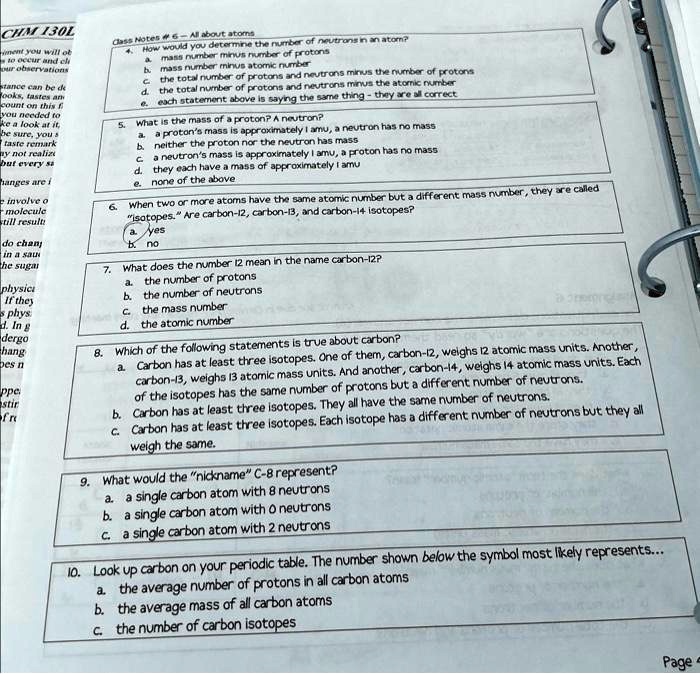
4. What is the mass of a proton? A neutron?
a. A proton's mass is approximately 1 amu, a neutron has no mass.
b. Neither the proton nor the neutron has mass.
c. A neutron's mass is approximately 1 amu, a proton has no mass.
d. They each have a mass of approximately 1 amu.
e. None of the above.
5. If you needed to take a look at it, be sure you taste it. Remarkably, you may not realize changes are involved until results are obtained.
6. Are carbon-12, carbon-13, and carbon-14 isotopes?
a. Yes, they do change.
b. No, in a sample of sugar.
c. The same.
d. The atomic number.
e. They undergo change.
7. What does the number 12 mean in the name carbon-12?
a. The number of protons.
b. The number of neutrons.
c. The mass number.
d. The atomic number.
e. They undergo change.
8. Which of the following statements is true about carbon?
a. Carbon has at least three isotopes. One of them, carbon-12, weighs 12 atomic mass units. Another, carbon-13, weighs 13 atomic mass units. And another, carbon-14, weighs 14 atomic mass units. Each type of the isotopes has the same number of protons but a different number of neutrons.
b. Carbon has at least three isotopes. They all have the same number of neutrons.
c. Carbon has at least three isotopes. Each isotope has a different number of neutrons but they all weigh the same.
9. What would the "nickname" C-8 represent?
a. A single carbon atom with 8 neutrons.
b. A single carbon atom with 0 neutrons.
c. A single carbon atom with 2 neutrons.
10. Look up carbon on your periodic table. The number shown below the symbol most likely represents...
a. The average number of protons in all carbon atoms.
b. The average mass of all carbon atoms.
c. The number of carbon isotopes.