Ace - AI Tutor
Ask Our Educators
Textbooks
My Library
Flashcards
Scribe - AI Notes
Notes & Exams
Download App
mark taylor

mark t.

Divider

Questions asked

BEST MATCH

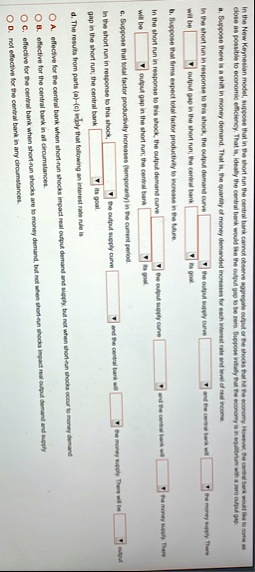
In the New Keynesian model, suppose that in the short run the central bank cannot observe aggregate output or the shocks that hit the economy. However, the central bank would like to come as close as possible to economic efficiency. That is, ideally the central bank would like the output gap to be zero. Suppose initially that the economy is in equilibrium with a zero output gap. a. Suppose there is a shift in money demand. That is, the quantity of money demanded increases for each interest rate and level of real income. In the short run in response to this shock, the output demand curve will be and the central bank will the money supply. There output gap in the short run; the central bank Its goal the output supply curve b. Suppose that firms expect total factor productivity to increase in the future. In the short run in response to this shock, the output demand curve will be and the central bank will the money supply. There c. Suppose that total factor productivity increases (temporarily) in the current period. In the short run in response to this shock, the output supply curve and the central bank will the money supply. There will be output gap in the short run; the central bank its goal gap in the short run; the central bank the output supply curve â–¼its goal. d. The results from parts (a)-(c) inply that following an interest rate rule is A. effective for the central bank when short-run shocks impact real output demand and supply, but not when short-run shocks occur to money demand B. effective for the central bank in all circumstances. OC. effective for the central bank when short-run shocks are to money demand, but not when short-run shocks impact real output demand and supply D. not effective for the central bank in any circumstances.
View Answer
divider
BEST MATCH

Which of the following organs does not belong to the cardiovascular system? Group of answer choices Blood Arteries Heart Marrow

View Answer
divider
BEST MATCH

The organ called ___ is involved in breaking up of old erythrocytes because it contains macrophages. Select one: a. spleen b. bone marrow c. lungs d. heart e. kidney

View Answer
divider
BEST MATCH

2) Derive the differential equation that defines $v_c(t)$ for $t > 0$. 0.5H 5$\Omega$ i 2F $v_c$ at $t = 0$, $v_c = 10V$ $i_c = 0A$

View Answer
divider
BEST MATCH

27. Show the $S_N2$ ring opening mechanism for the following reaction with an epoxide. Show stereochemistry at stereogenic centers if any are present. [1] $SCH_3^-$ [2] $H_2O$ 28. Determine the mechanism for the following reaction ($S_N1$, $S_N2$, E1, or E2). Show the mechanism and product(s). Determine the major product if one is present. $H_2SO_4$

View Answer
divider
BEST MATCH

Your answer is incorrect. Which HIV test requires a follow-up confirming, antigen test? O a nucleic acid test O a rapid point of care test O a combination antigen/antibody test O all of the above

View Answer
divider
BEST MATCH

38) In the long run, the Gulf of Tonkin Resolution can be evaluated as

View Answer
divider
BEST MATCH

Which of the following is not a potential side effect of tricyclic antidepressants? Group of answer choices Anticholinergic effects Hypertension Sexual dysfunction Prolonged QT interval

View Answer
divider
BEST MATCH

Releasing hormones originate in the: anterior pituitary hypothalamus posterior pituitary pineal

View Answer
divider
BEST MATCH

Which of the following is NOT true about disclosure? Which of the following is NOT true about disclosure? Disclosure should be based on the person’s skills, not their disability. Disclosure may occur before, during, or after the hiring process. Disclosure should come from the job seeker, not the employment professional. Disclosure of a disability prevents the employer from asking for proof of the disability.

View Answer
divider