Step 1.
Set up hypotheses and determine level of significance
Ho:
Ha: Should the alternative hypothesis be upper-tailed, lower-tailed, or two-tailed?
α=
Select the appropriate test statistic
Insert Specific Formula (Consider sample size to determine Z-score or T-distribution)
Step 3. Set up decision rule
Step 4.
Do NOT use your level of significance as a part of your decision rule. Be sure to use
only the critical values found in your appendices. Critical values are based upon the type
of test used, your sample size or degrees of freedom, your alternative hypothesis
(upper-tailed, lower-tailed, or two-tailed), and your level of significance.
When using a two-tailed test, be sure to include both positive and negative values of the
critical value.
Be sure to include the equal sign. For example, "Reject Ho if Z≥ 1.960."
Compute the test statistic.
Please show all computations. If you do not show your computations, you will not
receive credit, even if your test statistic is correct.
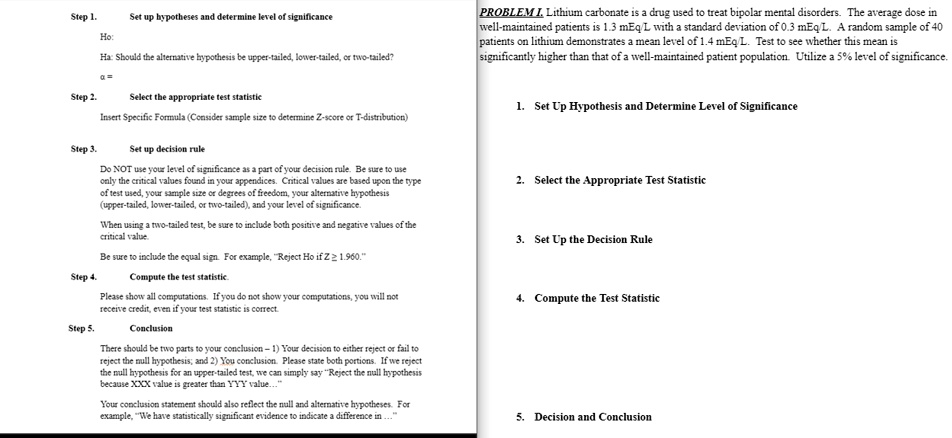
PROBLEM I. Lithium carbonate is a drug used to treat bipolar mental disorders. The average dose in
well-maintained patients is 1.3 mEq/L with a standard deviation of 0.3 mEq/L. A random sample of 40
patients on lithium demonstrates a mean level of 1.4 mEq/L. Test to see whether this mean is
significantly higher than that of a well-maintained patient population. Utilize a 5% level of significance.
1. Set Up Hypothesis and Determine Level of Significance
2. Select the Appropriate Test Statistic
3. Set Up the Decision Rule
4. Compute the Test Statistic
Step 5.
Conclusion
There should be two parts to your conclusion-1) Your decision to either reject or fail to
reject the null hypothesis; and 2) You conclusion. Please state both portions. If we reject
the null hypothesis for an upper-tailed test, we can simply say "Reject the null hypothesis
because XXX value is greater than YYY value..."
Your conclusion statement should also reflect the null and alternative hypotheses. For
example, "We have statistically significant evidence to indicate a difference in..."
5. Decision and Conclusion