Ace - AI Tutor
Ask Our Educators
Textbooks
My Library
Flashcards
Scribe - AI Notes
Notes & Exams
Download App
mark wong

mark w.

Divider

Questions asked

BEST MATCH

Which one of the following solutions will have the greatest concentration of hydroxide ions? 1. 68 M lithium hydroxide 2. 560 M potassium hydroxide 3. 68 M hydrobromic acid 4. 560 M calcium hydroxide 5. 560 M hydrochloric acid

View Answer
divider
BEST MATCH

What is the entropy change when 1.90 moles of CHCl3 condenses at 61.0 °C? [∆H(vap) = 29.6 kJ/mol at 61.0 °C]

View Answer
divider
BEST MATCH

Gautam just purchased a new house for Rs. 12,00,000. He was able to make a down payment equal to 25% of the value of the house; the balance was mortgaged. The rate by the bank is 10% compounded annually. The mortgage has a 20-year amortization period (this means that payments are calculated assuming it will take 20 years to pay off the loan). 1. What will be the size of the payments by factor formula? 2. What will be the balance remaining on the mortgage after 5 years?

View Answer
divider
BEST MATCH

The United States is an example of: The Anglo-Saxon model The continental model The ASEAN model The international model

View Answer
divider
BEST MATCH

For an object that rolls without slipping, there is a direct algebraic relationship between its angular velocity and a) its moment of inertia b) its mass c) the velocity of its center of mass d) its angular acceleration e) none of these

View Answer
divider
BEST MATCH

2. P and Q are determined by a system of equations. Solve for P and Q. Q = 2P - 250 P = 500 - Q

View Answer
divider
BEST MATCH

Consider the scattering of particles with energy $E = \frac{\hbar^2 k^2}{2m}$ from a thin 3D shell of radius $r = a$: $V(r) = V_0 a \delta(r - a)$. (a) Calculate the differential cross section $\frac{d\sigma}{d\Omega}$ in the Born approximation. Express your answer in terms of $\theta$ and $k$. (b) What is the lowest energy $E$ for which there will be no backscattering? (c) The total cross section near $E = 0$ can be written as $\sigma(E) = \sigma_0 (1 + \alpha E/E_a + ...)$ where $E_a = \frac{\hbar^2}{2ma^2}$ as usual. Find $\sigma_0$ and $\alpha$. (d) Can you interpret your result for part (b)? In particular, why doesn't it depend on $V_0$? (Hint: the answer has to do with one of the pillars.)

View Answer
divider
BEST MATCH

(1 point) (a) Suppose that the acceleration function of a particle moving along a coordinate line is $a(t) = t + 7$. Find the average acceleration of the particle over the time interval $0 \le t \le 8$ by integrating. $a_{ave} =$ (b) Suppose that the velocity function of a particle moving along a coordinate line is $v(t) = -3 \cos(t)$. Find the average acceleration of the particle over the time interval $0 \le t \le \frac{\pi}{4}$ algebraically. $a_{ave} = $

View Answer
divider
BEST MATCH

Find the and term in the expansion of (a+b)^(9) in simplest form.

View Answer
divider
BEST MATCH

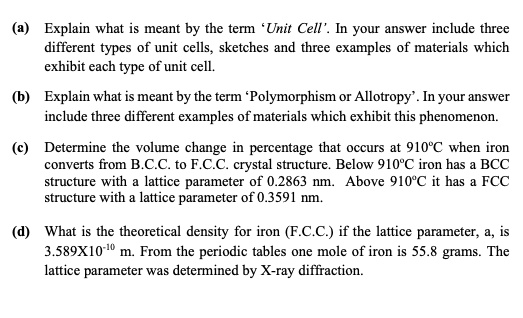
(a) Explain what is meant by the term 'Unit Cell'. In your answer include three different types of unit cells, sketches and three examples of materials which exhibit each type of unit cell. (b) Explain what is meant by the term 'Polymorphism or Allotropy'. In your answer include three different examples of materials which exhibit this phenomenon. (c) Determine the volume change in percentage that occurs at 910°C when iron converts from B.C.C. to F.C.C. crystal structure. Below 910°C iron has a BCC structure with a lattice parameter of 0.2863 nm. Above 910°C it has a FCC structure with a lattice parameter of 0.3591 nm. (d) What is the theoretical density for iron (F.C.C.) if the lattice parameter, a, is 3.589X10$^{-10}$ m. From the periodic tables one mole of iron is 55.8 grams. The lattice parameter was determined by X-ray diffraction.
View Answer
divider