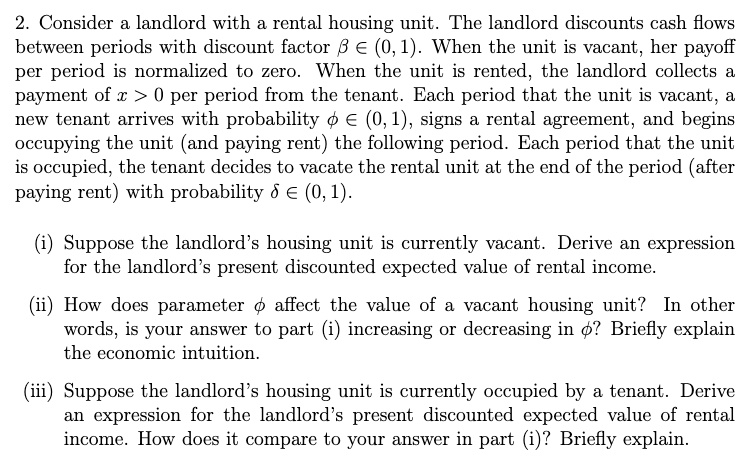
2. Consider a landlord with a rental housing unit. The landlord discounts cash flows
between periods with discount factor ?? (0,1). When the unit is vacant, her payoff
per period is normalized to zero. When the unit is rented, the landlord collects a
payment of x > 0 per period from the tenant. Each period that the unit is vacant, a
new tenant arrives with probability ? ? (0,1), signs a rental agreement, and begins
occupying the unit (and paying rent) the following period. Each period that the unit
is occupied, the tenant decides to vacate the rental unit at the end of the period (after
paying rent) with probability ?? (0, 1).
(i) Suppose the landlord's housing unit is currently vacant. Derive an expression
for the landlord's present discounted expected value of rental income.
(ii) How does parameter ? affect the value of a vacant housing unit? In other
words, is your answer to part (i) increasing or decreasing in ?? Briefly explain
the economic intuition.
(iii) Suppose the landlord's housing unit is currently occupied by a tenant. Derive
an expression for the landlord's present discounted expected value of rental
income. How does it compare to your answer in part (i)? Briefly explain.