*Aluminum-lithium phase diagram: Note that there is appreciable solubility of lithium in aluminum, particularly at high temperatures. Therefore, we can designate the (Al) region as ' \( \alpha \) '. The AlLi compound is not a line compound at high temperatures, but rather has a range of stoichiometry. Therefore, we can designate \( \beta= \) AlLi
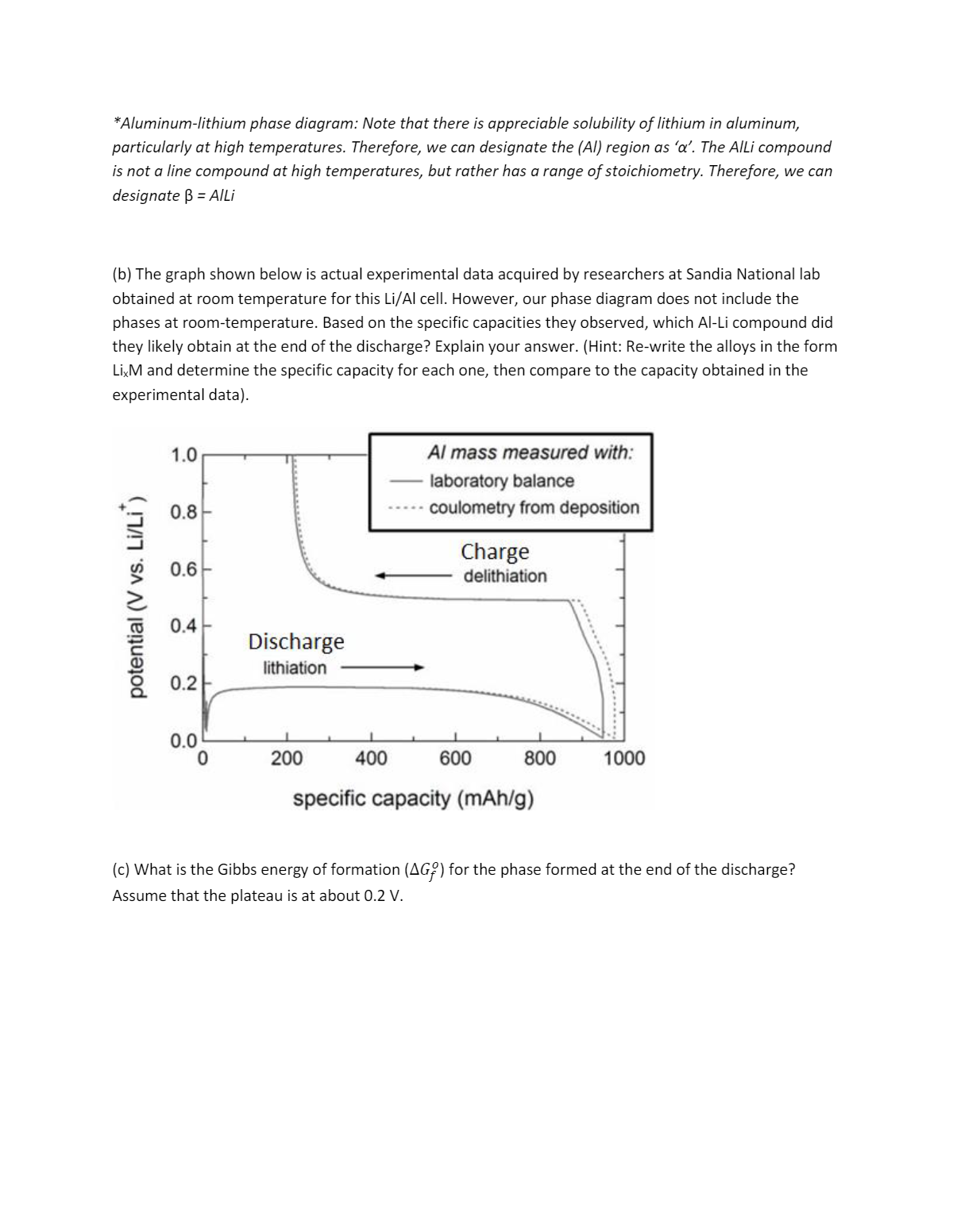
(b) The graph shown below is actual experimental data acquired by researchers at Sandia National lab obtained at room temperature for this Li/Al cell. However, our phase diagram does not include the phases at room-temperature. Based on the specific capacities they observed, which Al-Li compound did they likely obtain at the end of the discharge? Explain your answer. (Hint: Re-write the alloys in the form \( \mathrm{Li}_{\mathrm{x}}^{\mathrm{M}} \) and determine the specific capacity for each one, then compare to the capacity obtained in the experimental data).
(c) What is the Gibbs energy of formation \( \left(\Delta G_{f}^{o}\right) \) for the phase formed at the end of the discharge? Assume that the plateau is at about \( 0.2 \mathrm{~V} \).