When there's no heat flow ("adiabatic") slow expansion/contraction (staying very close to equilibrium) cannot change S. Let's see how that works out for a specific material.
The entropy of an a-ideal gas changes in the following way as a function of temperature and volume:
$\Delta S = nR \ln(V_f/V_i) + \alpha nR \ln(T_f/T_i)$,
where $\alpha = N_{DOF}/2$.
For an adiabatic process, the change in T is determined by the change in V. In this problem you will compute the contributions to S from the V and T terms separately, then add them up to find the total entropy change for an adiabatic process.
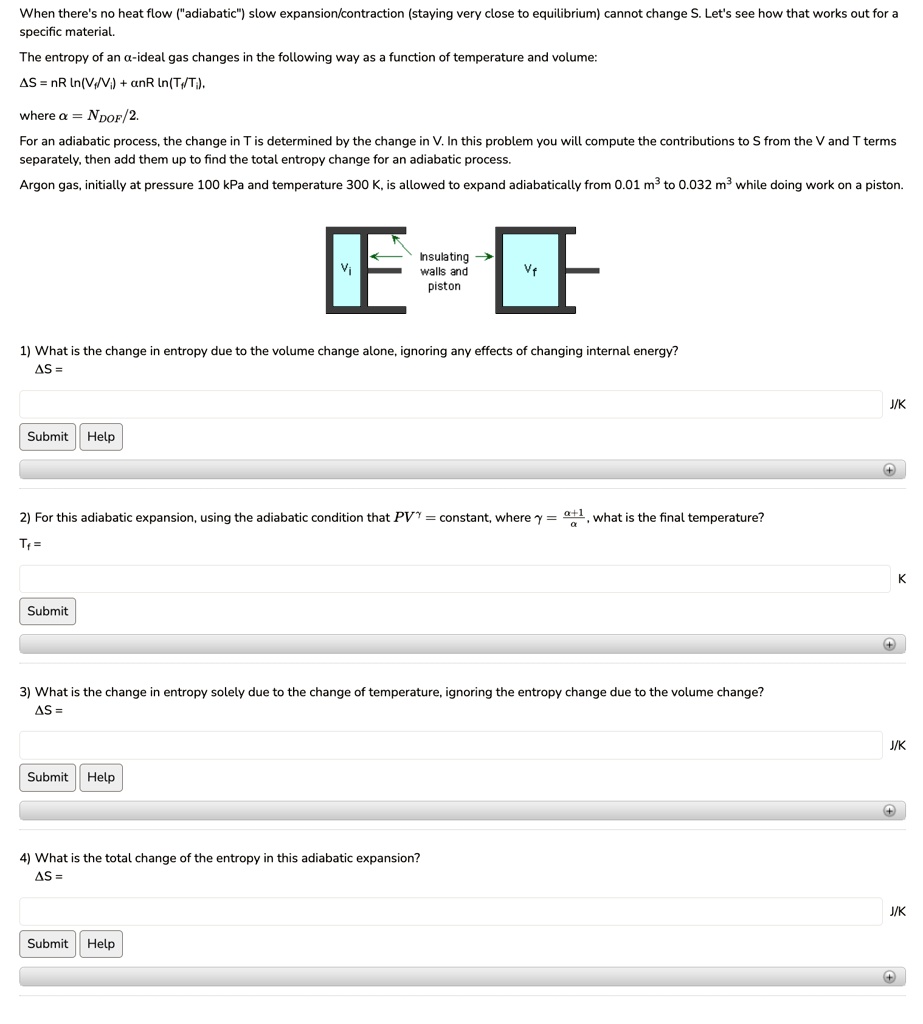
Argon gas, initially at pressure 100 kPa and temperature 300 K, is allowed to expand adiabatically from 0.01 m³ to 0.032 m³ while doing work on a piston.
1) What is the change in entropy due to the volume change alone, ignoring any effects of changing internal energy?
$\Delta S = $
2) For this adiabatic expansion, using the adiabatic condition that $PV^\gamma = \text{constant}$, where $\gamma = \frac{\alpha + 1}{\alpha}$, what is the final temperature?
$T_f = $
3) What is the change in entropy solely due to the change of temperature, ignoring the entropy change due to the volume change?
$\Delta S = $
4) What is the total change of the entropy in this adiabatic expansion?
$\Delta S = $