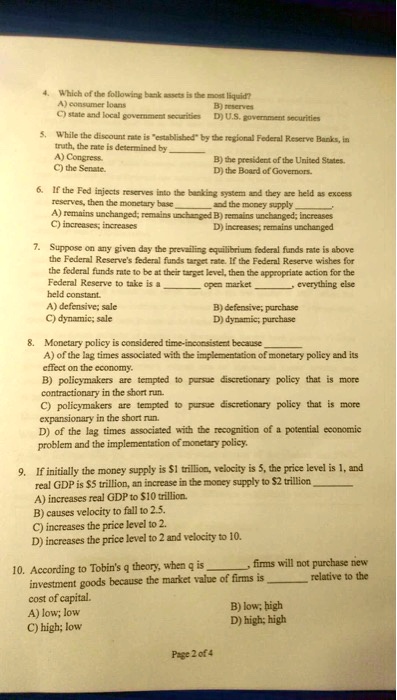
4. Which of the following bank assets is the most liquid? A consumer loans B reserves C state and local government securities D U.S. government securities
5. While the discount rate is established by the regional Federal Reserve Banks, in truth, the rate is determined by A Congress. B the president of the United States. C the Senate D the Board of Governors.
6. If reserves, then the monetary base and the money supply A remains unchanged; remains unchanged B remains unchanged; increases C increases; increases D increases; remains unchanged
7. q s pma oddn the Federal Reserve's federal funds target rate. If the Federal Reserve wishes for the federal funds rate to be at a higher level, then the appropriate action for the Federal Reserve to take is a open market sale, everything else held constant. A defensive; sale B defensive; purchase C dynamic; sale D dynamic; purchase
8. Monetary policy is considered time-inconsistent because A of the lag times associated with the implementation of monetary policy and its effect on the economy B contractionary in the short run C policymakers are tempted to pursue discretionary policy that is more expansionary in the short run.
9. If initially the money supply is $1 trillion, velocity is 5, the price level is 1, and real GDP is $5 trillion, an increase in the money supply to $2 trillion A increases real GDP to $10 trillion B causes velocity to fall to 2.5. C increases the price level to 2. D increases the price level to 2 and velocity to 10.
10. According to Tobin's q theory, when q is low, firms will not purchase new investment goods because the market value of firms is low relative to the cost of capital. A low: low B low: high C high: high D high: low