Using a wind tunnel test, we are trying to estimate the drag as a function of yaw angle for a truck traveling at a speed of 100 km/h. We plan to measure yaw angles up to 30°. We have a 1/6 scale model of the truck for testing in the tunnel. The tunnel has a maximum speed of 130 km/h.
1. What speed would you choose to run the wind tunnel at?
2. What is the estimated drag on the full-scale truck at zero yaw angle?
3. What assumption are we forced to make regarding the dynamical similarity of the wind-tunnel and real-life flows?
4. Would the error introduced by this assumption be smaller or larger for a more streamlined vehicle such as the Aurora solar vehicle?
5. Do you anticipate blockage being a problem? If so, will blockage effects cause us to over or underestimate the drag on the full-sized vehicle?
6. At what yaw angle do you expect blockage to have the greatest effect?
Additional data are given below:
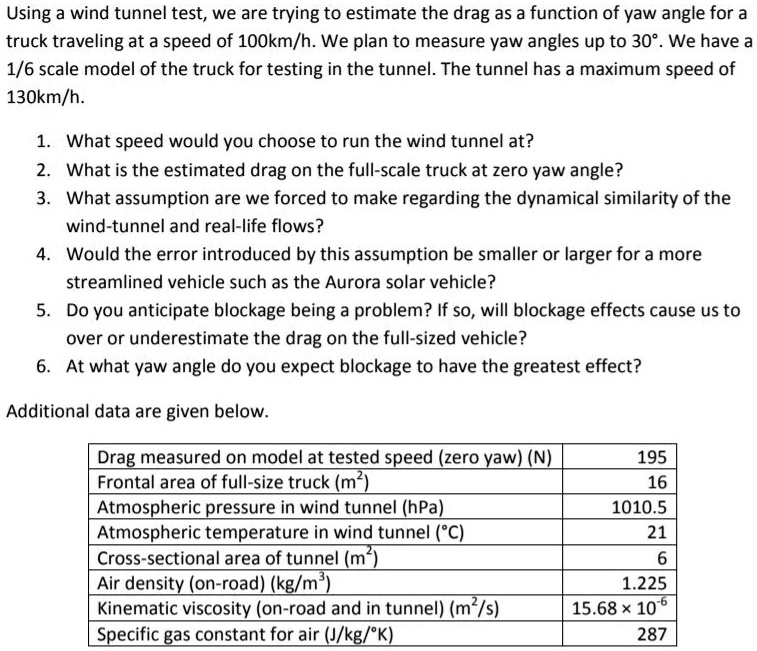
- Drag measured on model at tested speed (zero yaw): 195 N
- Frontal area of full-size truck: 16 m²
- Atmospheric pressure in wind tunnel: 1010.5 hPa
- Atmospheric temperature in wind tunnel: 21°C
- Cross-sectional area of tunnel: 6 m²
- Air density (on-road): 1.225 kg/m³
- Kinematic viscosity (on-road and in tunnel): 1.568 × 10â»â¶ m²/s
- Specific gas constant for air: 287 J/kg/K