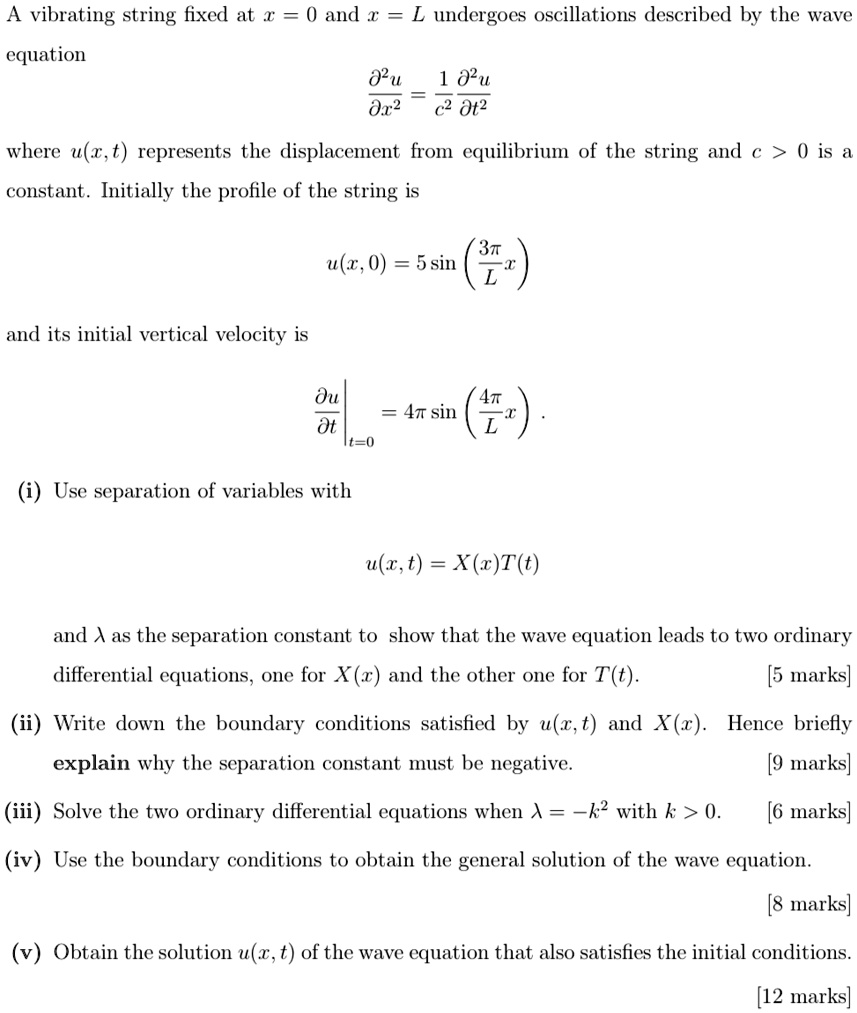
A vibrating string fixed at \(x = 0\) and \(x = L\) undergoes oscillations described by the wave
equation
\(\frac{\partial^2 u}{\partial x^2} = \frac{1}{c^2} \frac{\partial^2 u}{\partial t^2}\)
where \(u(x, t)\) represents the displacement from equilibrium of the string and \(c > 0\) is a
constant. Initially the profile of the string is
\(u(x, 0) = 5 \sin\left(\frac{3\pi}{L} x\right)\)
and its initial vertical velocity is
\(\left.\frac{\partial u}{\partial t}\right|_{t=0} = 4\pi \sin\left(\frac{4\pi}{L} x\right)\).
(i) Use separation of variables with
\(u(x, t) = X(x)T(t)\)
and \(\lambda\) as the separation constant to show that the wave equation leads to two ordinary
differential equations, one for \(X(x)\) and the other one for \(T(t)\).
[5 marks]
(ii) Write down the boundary conditions satisfied by \(u(x, t)\) and \(X(x)\). Hence briefly
explain why the separation constant must be negative.
[9 marks]
(iii) Solve the two ordinary differential equations when \(\lambda = -k^2\) with \(k > 0\).
[6 marks]
(iv) Use the boundary conditions to obtain the general solution of the wave equation.
[8 marks]
(v) Obtain the solution \(u(x, t)\) of the wave equation that also satisfies the initial conditions.
[12 marks]