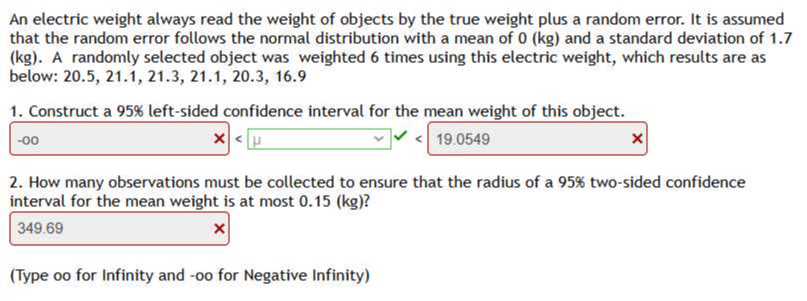
An electric weight always read the weight of objects by the true weight plus a random error. It is assumed that the random error follows the normal distribution with a mean of \( 0(\mathrm{~kg}) \) and a standard deviation of 1.7 (kg). A randomly selected object was weighted 6 times using this electric weight, which results are as below: \( 20.5,21.1,21.3,21.1,20.3,16.9 \)
1. Construct a \( 95 \% \) left-sided confidence interval for the mean weight of this object.
\[
\begin{array}{|ll}
-\infty & x \\
& <
\end{array}
\]
\( \square \)
\( \square \) 19.0549 \( \checkmark< \)
2. How many observations must be collected to ensure that the radius of a \( 95 \% \) two-sided confidence interval for the mean weight is at most 0.15 ( kg )?
349.69 \( \square \)
(Type oo for Infinity and -oo for Negative Infinity)