2.54 The steel rails of a railroad track ($E_s$ = 200 GPa, $\alpha_s$ = 11.7 $\times$ $10^{-6}$/°C) were laid at a temperature of 6°C. Determine the normal stress in the rails when the temperature reaches 48°C, assuming that the rails (a) are welded to form a continuous track, (b) are 10 m long with 3-mm gaps between them.
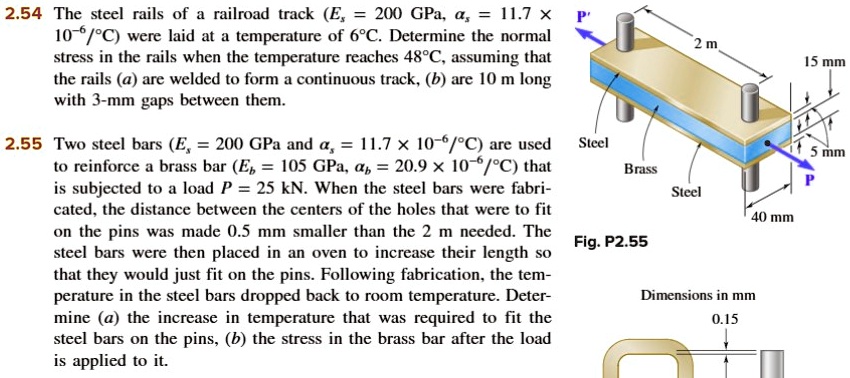
2.55 Two steel bars ($E_s$ = 200 GPa and $\alpha_s$ = 11.7 $\times$ $10^{-6}$/°C) are used to reinforce a brass bar ($E_b$ = 105 GPa, $\alpha_b$ = 20.9 $\times$ $10^{-6}$/°C) that is subjected to a load P = 25 kN. When the steel bars were fabricated, the distance between the centers of the holes that were to fit on the pins was made 0.5 mm smaller than the 2 m needed. The steel bars were then placed in an oven to increase their length so that they would just fit on the pins. Following fabrication, the temperature in the steel bars dropped back to room temperature. Determine (a) the increase in temperature that was required to fit the steel bars on the pins, (b) the stress in the brass bar after the load is applied to it.
Fig. P2.55
Dimensions in mm
0.15