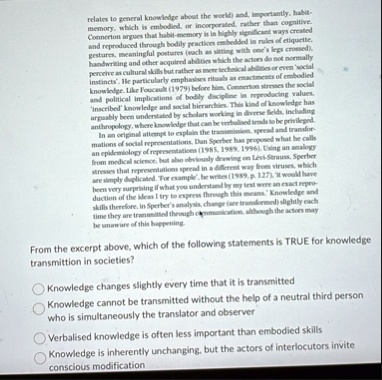
relates to general knowledge about the world) and importantly, habitmemory, which is embodied. or incorporated. rather than cognitive. Connertion argues that halit-memory if to helply shilleant ways created and reproduced through bodily practions cmbedded in rules of etiquette. gestures, meaningful postures (sach as sitting with one's legs crossed). handwriting and other acquired abilities which the action do not normally perceive as cultural skills but rather as meer iechnical ablities er even 'secial instinets'. He particularly emphasises rituals as enactments of embodied knowledge. Ulke Foucault (1979) belore lime, Coenerson stresses the social and political implications of bodily disclopline in reproducing values. 'inscribed' knowledge and social hierarchies. This kind of knowledge has arguably been understated by scholars worling in diverse felds. including antiropology, where knowledge that can be vertudised trads to be privileged.
In an original attempt to esplain the trammodion, spread and transformations of social representations. Dan Sperter has proposed what he calls an epidemiology of representations (1985, 1989, 1996). Usiag an analogy from medical science. leit also obviously drawing cen Levi-Sirauss, Sperber thresses that representations spread in a different way from viruses, which are simply duplicated. Tor example', be writes (1959.p. 127), 't would have been very surprising if what you understand lon my terst were an exact reproduction of the ideas 1 try to espress through this means. 'Knowledge and skills therefore, in Sperter's analysis, change (arre trambormed) slightly each time they are tranumiltiel throuph capmmakation, alhough the actors may be unawire of this happening.
From the excerpt above, which of the following statements is TRUE for knowledge transmittion in societies?
Knowledge changes slightly every time that it is transmitted
Knowledge cannot be transmitted without the help of a neutral third person who is simultaneously the translator and observer
Verbalised knowledge is often less important than embodied skills
Knowledge is inherently unchanging, but the actors of interlocutors invite conscious modification