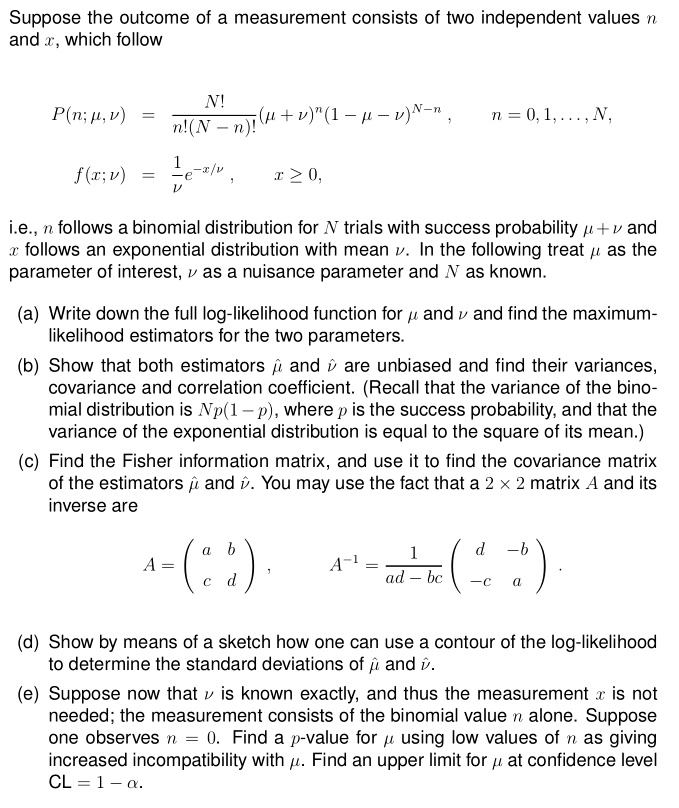
Suppose the outcome of a measurement consists of two independent values n and λ, which follow
P(n; λ) = (N choose n) (λ/(λ+1))^n (1/(λ+1))^(N-n)
0 ≤ n ≤ N,
λ > 0,
i.e., n follows a binomial distribution for N trials with success probability λ/(λ+1) and follows an exponential distribution with mean λ. In the following, treat λ as the parameter of interest; v as a nuisance parameter, and N as known:
(a) Write down the full log-likelihood function for λ and v and find the maximum-likelihood estimators for the two parameters.
(b) Show that both estimators λ and v are unbiased and find their variances, covariance, and correlation coefficient. (Recall that the variance of the binomial distribution is Np(1-p), where p is the success probability; and that the variance of the exponential distribution is equal to the square of its mean.)
(c) Find the Fisher information matrix and use it to find the covariance matrix of the estimators λ and v. You may use the fact that a 2 x 2 matrix A and its inverse are
A = (σ^2),
A^(-1) = (1/σ^2).
(d) Show by means of a sketch how one can use a contour of the log-likelihood to determine the standard deviations of λ and v.
Suppose now that v is known exactly, and thus the measurement λ is not needed; the measurement consists of the binomial value n alone. Suppose one observes n. Find a p-value for λ using low values of n as giving increased incompatibility with λ. Find an upper limit for λ at confidence level CL = [e^(-1)].