A dietitian in a hospital is to arrange a special diet using two foods. Each ounce of food M contains 40 units of calcium,
10 units of iron, and 10 units of vitamin A. Each ounce of food N contains 10 units of calcium, 10 units of iron, and 40
units of vitamin A. The minimum requirements in the diet are 560 units of calcium, 200 units of iron, and 380 units of
vitamin A. If x is the number of ounces of food M used and y is the number of ounces of food N used, write a system of
linear inequalities that reflects the conditions indicated. Find the set of feasible solutions graphically for the amounts of
each kind of food that can be used.
Write an inequality for the constraint on calcium.
?560
(Do not factor.)
Write an inequality for the constraint on iron.
?200
(Do not factor.)
Write an inequality for the constraint on vitamin A.
?380
(Do not factor.)
Which of the following inequalities are also needed, if any?
A. x?0 and y ?0
B. x?y
C. x?0 and y?0
D. No additional inequalities are needed.
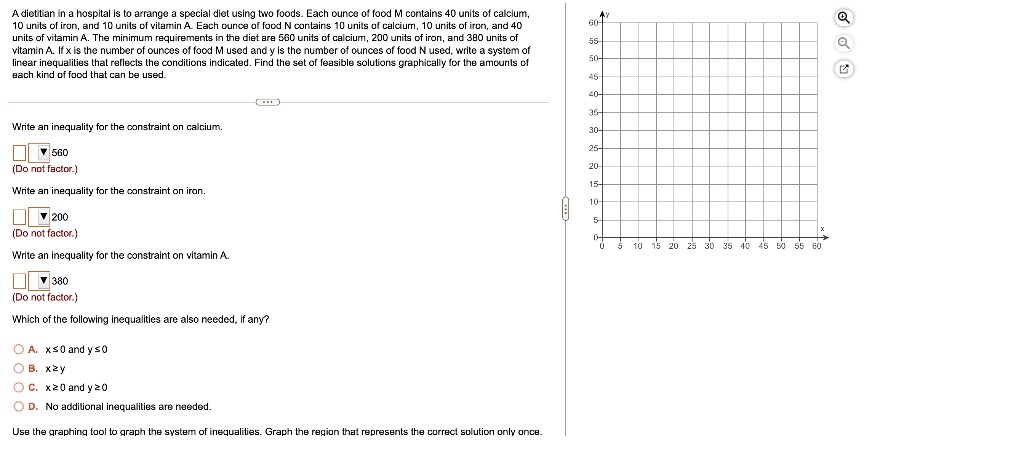
Use the graphing tool to graph the system of inequalities. Graph the region that represents the correct solution only once.