Ace - AI Tutor
Ask Our Educators
Textbooks
My Library
Flashcards
Scribe - AI Notes
Notes & Exams
Download App
mary hayes

mary h.

Divider

Questions asked

BEST MATCH

When we discuss osmosis, we reference the movement of water across a selectively permeable membrane from an area of low solute concentration to an area of high solute concentration. How is this similar to chemiosmosis as applied to oxidative phosphorylation and the electron transport chain? a. A high concentration of protons is created external to the inner mitochondrial membrane. b. The cytochrome complexes are integral membrane proteins of the inner mitochondrial membrane. c. The synthesis of ATP from ADP + Pi occurs in the mitochondrial matrix. d. The electron carriers (NADH and FADH2) are oxidized on the inside of the inner mitochondrial membrane. e. ATP synthase can be compared to a mechanical motor in its structure and how it functions.

View Answer
divider
BEST MATCH

The point at which a companys profits equal zero is called the companys break even point. let R represent a companys revenue, let C represent the companys costs, and let x represent the number of units produced and sold each day

View Answer
divider
BEST MATCH

Sort the items from the answer bank based on whether they are likely to characterize a chemical reaction with a change (?) in Gibbs free energy (G) that is either negative (-) or positive (+). For the purpose of this question, each category will contain one entropy term and one enthalpy term that must be opposite in sign. -?G +?G Answer Bank endergonic -?S exergonic +?S -?H spontaneous +?H nonspontaneous

View Answer
divider
BEST MATCH

Convert each of the following measurements or final calculations into milliliters. (259.0 cm \times 172.7 cm \times 310.8 cm)

View Answer
divider
BEST MATCH

Glucose Regulation If one says that the clearance value of glucose is nearly zero, what does this mean? The client has diabetes. Nearly 100% of glucose is reabsorbed. The clearance value of glucose is relatively high in a healthy adult. The glucose molecule is too large to be filtered out of the blood. Most of the glucose is filtered out of the blood and is not reabsorbed in the convoluted tubules

View Answer
divider
BEST MATCH

College textbook royalties are traditionally paid as a __________blank based on the price charged to __________blank. Multiple Choice percentage; bookstores percentage; the university/college fixed amount; students fixed amount; faculty

View Answer
divider
BEST MATCH

In meiosis, the first nuclear division separates ____, while the second nuclear division separates ____.

View Answer
divider
BEST MATCH

The standard Laplace distribution has density \(f(x) = \frac{1}{2} \exp(-|x|), x \in \mathbb{R}\) Generate a random sample of size 1000 from this distribution.

View Answer
divider
BEST MATCH

What would be the equivalent system that can represent the interconnected subsystems shown if the impulse responses are as follows h?(n) = 0.5? u(n), h?(n) = 4 u(n), h?(n) = h?(n) = u(n). Compute the output sequence if the input to this interconnected system is x(n) = u(n).

View Answer
divider
BEST MATCH

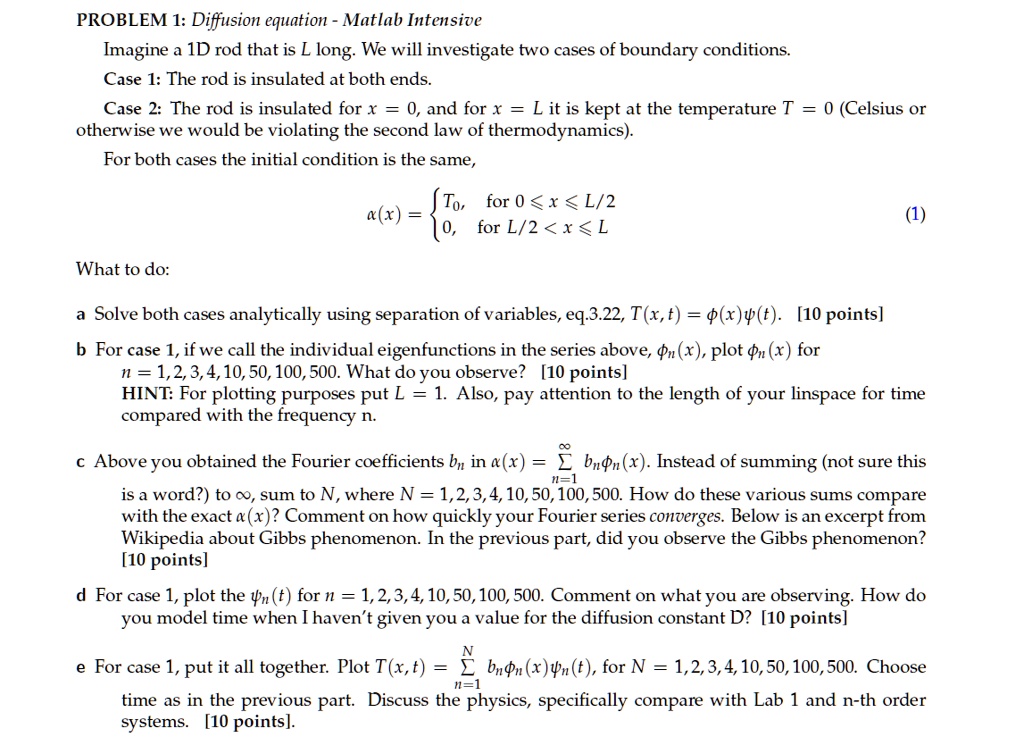
PROBLEM 1: Diffusion equation - Matlab Intensive Imagine a 1D rod that is L long. We will investigate two cases of boundary conditions: Case 1: The rod is insulated at both ends. Case 2: The rod is insulated for x = 0, and for x = L it is kept at the temperature T = 0 (Celsius or otherwise we would be violating the second law of thermodynamics). For both cases, the initial condition is the same: T(x, t) = 0, for 0 < x < L/2 0, for L/2 < x < L What to do: a) Solve both cases analytically using separation of variables, eq.3.22, T(x, t) = (x)(t). [10 points] b) For case 1, if we call the individual eigenfunctions in the series above, n(x), plot n(x) for n = 1, 2, 3, 4, 10, 50, 100, 500. What do you observe? [10 points] HINT: For plotting purposes, put L = 1. Also, pay attention to the length of your linspace for time compared with the frequency n. c) Above, you obtained the Fourier coefficients b_n in (x) = b_n * n(x). Instead of summing (not sure this is a word?) to infinity, sum to N, where N = 1, 2, 3, 4, 10, 50, 100, 500. How do these various sums compare with the exact (x)? Comment on how quickly your Fourier series converges. Below is an excerpt from Wikipedia about Gibbs phenomenon. In the previous part, did you observe the Gibbs phenomenon? [10 points] d) For case 1, plot n(t) for n = 1, 2, 3, 4, 10, 50, 100, 500. Comment on what you are observing. How do you model time when I haven't given you a value for the diffusion constant D? [10 points] e) For case 1, put it all together. Plot T(x, t) = b_n * n(x) * n(t), for N = 1, 2, 3, 4, 10, 50, 100, 500. Choose time as in the previous part. Discuss the physics, specifically compare with Lab 1 and n-th order systems. [10 points].
View Answer
divider