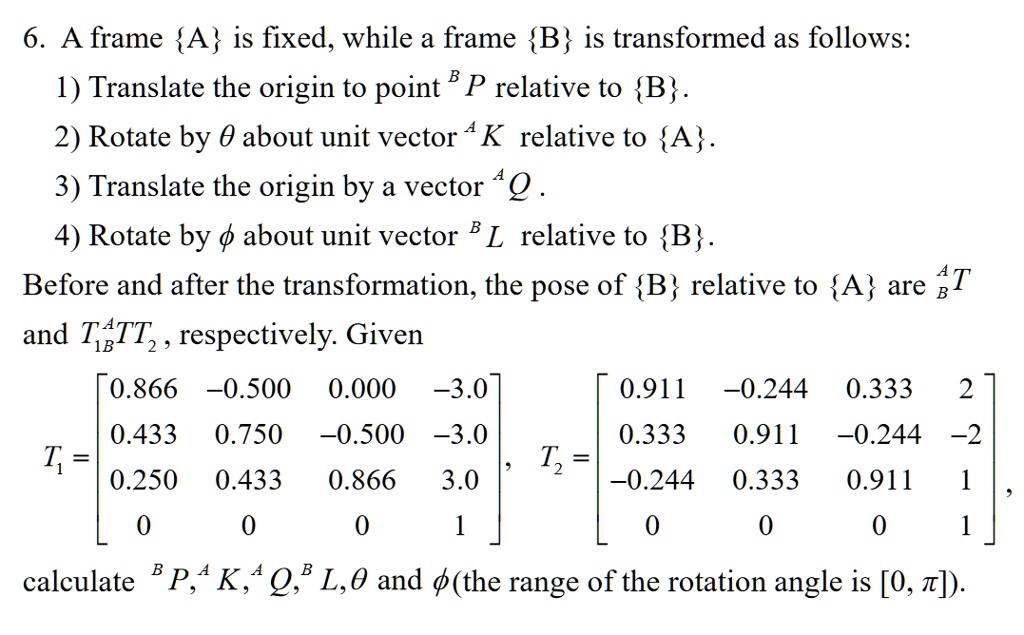
6. A frame {A} is fixed, while a frame {B} is transformed as follows:
1) Translate the origin to point $^B P$ relative to {B}.
2) Rotate by $\theta$ about unit vector $^A K$ relative to {A}.
3) Translate the origin by a vector $^A Q$.
4) Rotate by $\phi$ about unit vector $^B L$ relative to {B}.
Before and after the transformation, the pose of {B} relative to {A} are $^A_B T$ and $T_1 ^A_B T T_2$, respectively. Given
$\begin{bmatrix} 0.866 & -0.500 & 0.000 & -3.0 \\ 0.433 & 0.750 & -0.500 & -3.0 \\ 0.250 & 0.433 & 0.866 & 3.0 \\ 0 & 0 & 0 & 1 \end{bmatrix}$, $T_2 = \begin{bmatrix} 0.911 & -0.244 & 0.333 & 2 \\ 0.333 & 0.911 & -0.244 & -2 \\ -0.244 & 0.333 & 0.911 & 1 \\ 0 & 0 & 0 & 1 \end{bmatrix}$,
calculate $^B P$, $^A K$, $^A Q$, $^B L$, $\theta$ and $\phi$(the range of the rotation angle is $[0, \pi]).$