Viewed Questions
There are two contributing resonance structures for an anion called acetaldehyde enolate, whose condensed molecular formula is $\mathrm{CH}_{2} \mathrm{CHO}^{-}$. Draw the two resonance contributors and the resonance hybrid, then consider the map of electrostatic potential (MEP) shown below for this anion. Comment on whether the MEP is consistent or not with predominance of the resonance contributor you would have predicted to be represented most strongly in the hybrid.
The spontaneous redox reaction of tin and aqueous copper(II) sulfate occurs according to the following ionic equation: $$ \mathrm{Sn}(s)+\mathrm{Cu}^{2+}(a q) \longrightarrow \mathrm{Cu}(s)+\mathrm{Sn}^{2+}(a q) $$ The half-reactions are separated into two compartments. A Sn electrode is placed in $1.00 \mathrm{M} \mathrm{SnSO}_{4},$ and a Cu electrode in $1.00 \mathrm{M} \mathrm{CuSO}_{4}$. Indicate each of the following for the voltaic cell: (a) oxidation half-cell reaction (b) reduction half-cell reaction (c) anode and cathode (d) direction of electron flow (e) direction of $\mathrm{SO}_{4}^{2-}$ in the salt bridge
Questions asked
Dominique Jan Tan
Numerade educator
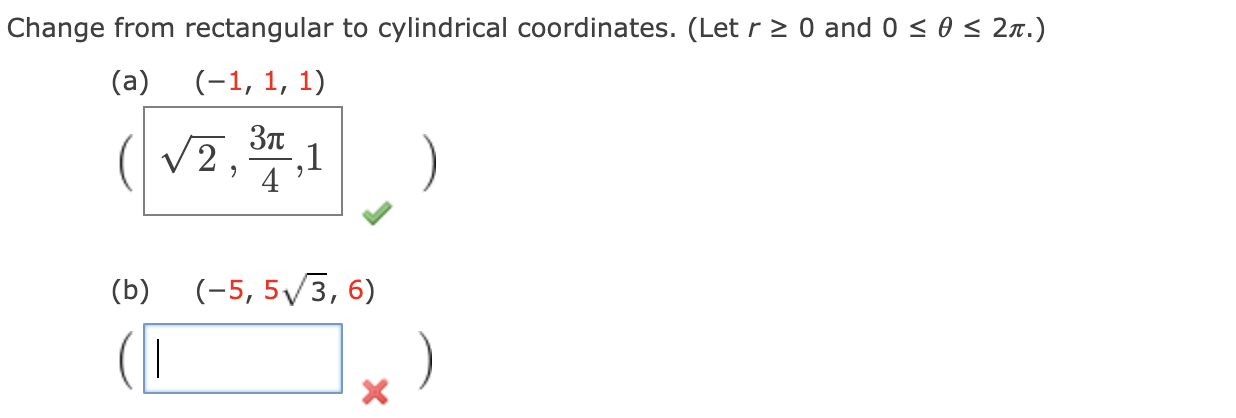
Change from rectangular to cylindrical coordinates. (Let ( r geq 0 ) and ( 0 leq heta leq 2 pi ).) (a) ( (-1,1,1) ) [ left(sqrt{2}, frac{3 pi}{4}, 1 ight) ] (b) ( (-5,5 sqrt{3}, 6) )
Melissa Munoz
Use cylindrical coordinates. Evaluate ( iiint_{E} sqrt{x^{2}+y^{2}} d V ), where ( E ) is the region that lies inside the cylinder ( x^{2}+y^{2}=9 ) and between the planes ( z=-6 ) and ( z=1 )