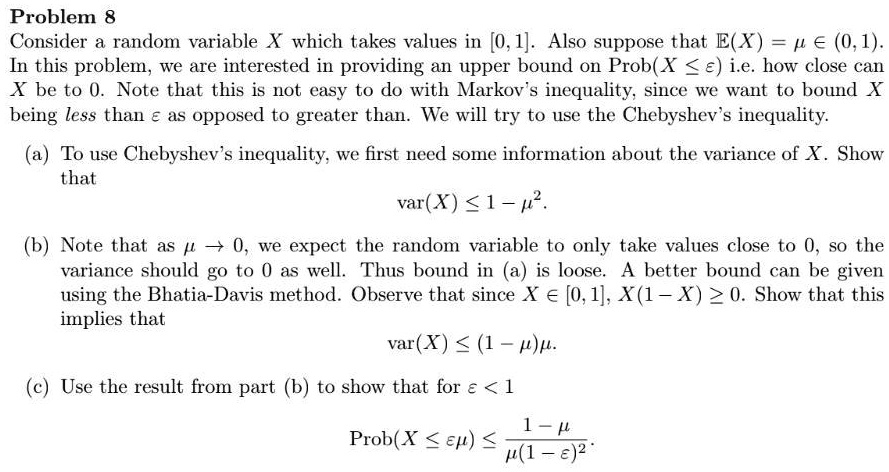
Problem 8
Consider a random variable X which takes values in [0,1]. Also suppose that E(X) = ?? (0,1).
In this problem, we are interested in providing an upper bound on Prob(X ? ?) i.e. how close can
X be to 0. Note that this is not easy to do with Markov's inequality, since we want to bound X
being less than e as opposed to greater than. We will try to use the Chebyshev's inequality.
(a) To use Chebyshev's inequality, we first need some information about the variance of X. Show
that
$\text{var}(X) \le 1 - \mu^2$.
(b) Note that as µ? 0, we expect the random variable to only take values close to 0, so the
variance should go to 0 as well. Thus bound in (a) is loose. A better bound can be given
using the Bhatia-Davis method. Observe that since X ? [0, 1], X(1-X) ? 0. Show that this
implies that
$\text{var}(X) \le (1 - \mu)\mu$.
(c) Use the result from part (b) to show that for ? < 1
$\text{Prob}(X \le \varepsilon\mu) \le \frac{1-\mu}{\mu(1-\varepsilon)^2}$