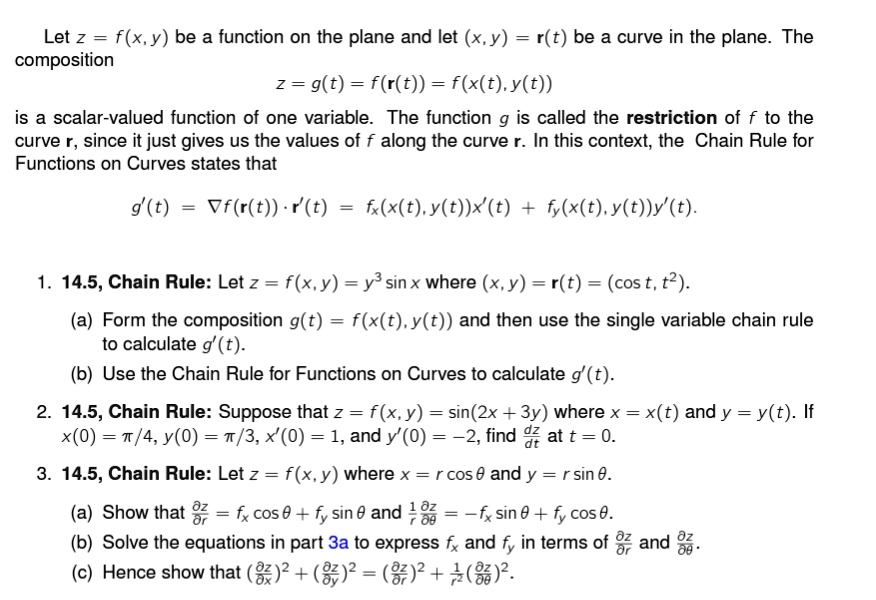
Let z = f(x, y) be a function on the plane and let (x, y) = r(t) be a curve in the plane. The composition z = g(t) = f(x(t), y(t)) is the function obtained by substituting the values of x(t) and y(t) into f. The derivative of g(t) with respect to t, denoted as g'(t), can be calculated using the chain rule for functions on curves:
g'(t) = ∂f/∂x * ∂x/∂t + ∂f/∂y * ∂y/∂t
1.14.5, Chain Rule: Let z = f(x, y) = y^3 * sin(x), where x = r(t) = cos(t) and y = s(t) = t^2.
(a) Form the composition g(t) = f(x(t), y(t)) = f(cos(t), t^2) and then use the single variable chain rule to calculate g'(t).
(b) Use the chain rule for functions on curves to calculate g'(t).
2. 14.5, Chain Rule: Suppose that z = f(x, y) = sin(2x) + 3y, where x = x(t) and y = y(t). If 0 = ∂z/∂x * ∂x/∂t + ∂z/∂y * ∂y/∂t, then find ∂z/∂x, ∂z/∂y, ∂x/∂t, and ∂y/∂t.
3. 14.5, Chain Rule: Let z = f(x, y), where x = r * cos(θ) and y = r * sin(θ).
(a) Show that ∂z/∂r = ∂f/∂x * cos(θ) + ∂f/∂y * sin(θ) and ∂z/∂θ = -∂f/∂x * sin(θ) + ∂f/∂y * cos(θ).
(b) Solve the equations in part (a) to express ∂f/∂x and ∂f/∂y in terms of ∂z/∂r and ∂z/∂θ.
(c) Hence, show that (∂z/∂r)^2 + (∂z/∂θ)^2 = (∂z/∂r)^2 + z^2.