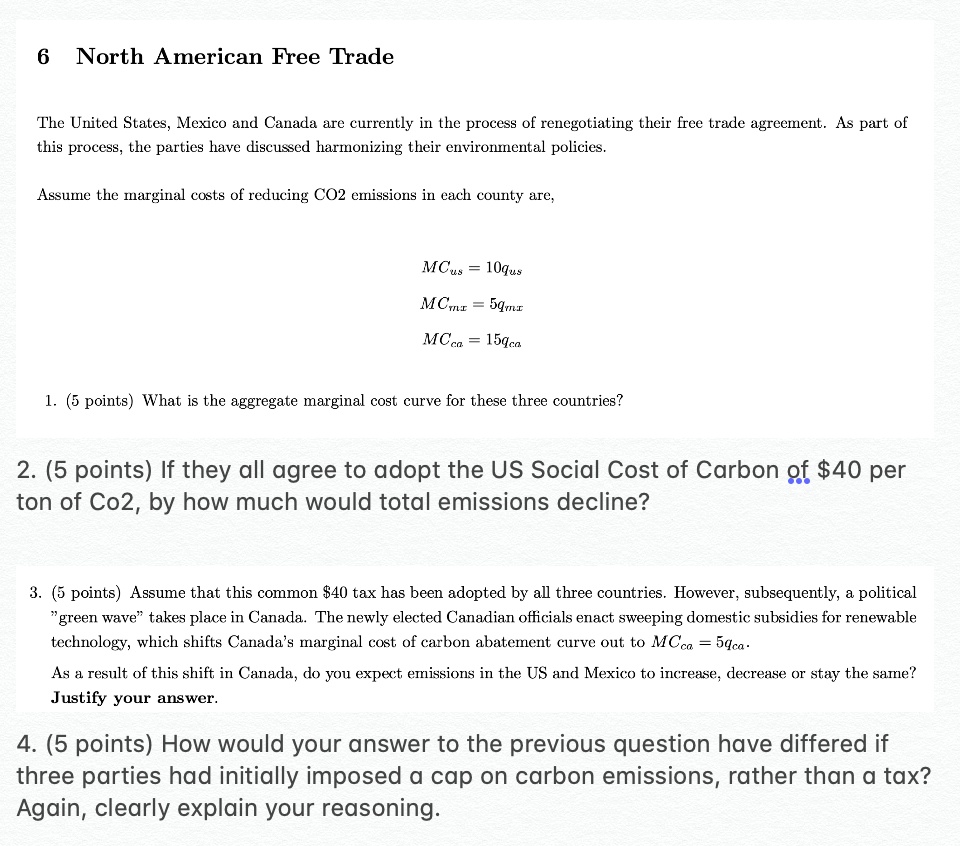
6 North American Free Trade
The United States, Mexico and Canada are currently in the process of renegotiating their free trade agreement. As part of
this process, the parties have discussed harmonizing their environmental policies.
Assume the marginal costs of reducing CO2 emissions in each county are,
$MC_{us} = 10q_{us}$
$MC_{mx} = 5q_{mx}$
$MC_{ca} = 15q_{ca}$
1. (5 points) What is the aggregate marginal cost curve for these three countries?
2. (5 points) If they all agree to adopt the US Social Cost of Carbon of $40 per
ton of Co2, by how much would total emissions decline?
3. (5 points) Assume that this common $40 tax has been adopted by all three countries. However, subsequently, a political
\"green wave\" takes place in Canada. The newly elected Canadian officials enact sweeping domestic subsidies for renewable
technology, which shifts Canada's marginal cost of carbon abatement curve out to $MC_{ca} = 5q_{ca}$.
As a result of this shift in Canada, do you expect emissions in the US and Mexico to increase, decrease or stay the same?
Justify your answer.
4. (5 points) How would your answer to the previous question have differed if
three parties had initially imposed a cap on carbon emissions, rather than a tax?
Again, clearly explain your reasoning.