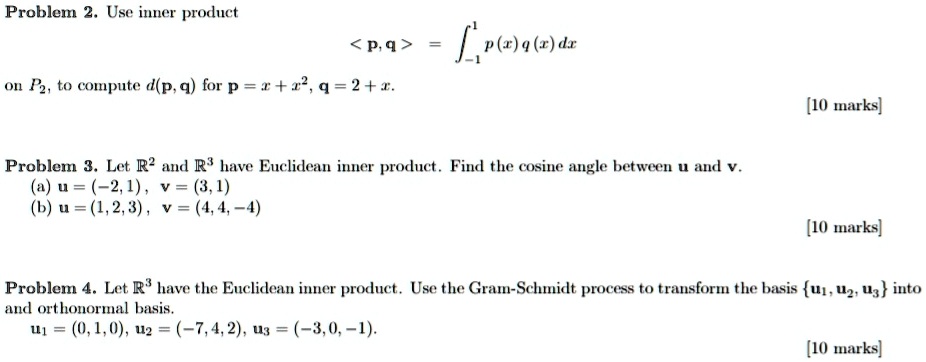
Problem 2. Use inner product
$<p, q> = \int_{-1}^{1} p(x) q(x) dx$
on $P_2$, to compute $d(p, q)$ for $p = x + x^2$, $q = 2 + x$.
[10 marks]
Problem 3. Let $\mathbb{R}^2$ and $\mathbb{R}^3$ have Euclidean inner product. Find the cosine angle between $\mathbf{u}$ and $\mathbf{v}$.
(a) $\mathbf{u} = (-2, 1)$, $\mathbf{v} = (3, 1)$
(b) $\mathbf{u} = (1, 2, 3)$, $\mathbf{v} = (4, 4, -4)$
[10 marks]
Problem 4. Let $\mathbb{R}^3$ have the Euclidean inner product. Use the Gram-Schmidt process to transform the basis $\{\mathbf{u}_1, \mathbf{u}_2, \mathbf{u}_3\}$ into and orthonormal basis.
$\mathbf{u}_1 = (0, 1, 0)$, $\mathbf{u}_2 = (-7, 4, 2)$, $\mathbf{u}_3 = (-3, 0, -1)$.
[10 marks]