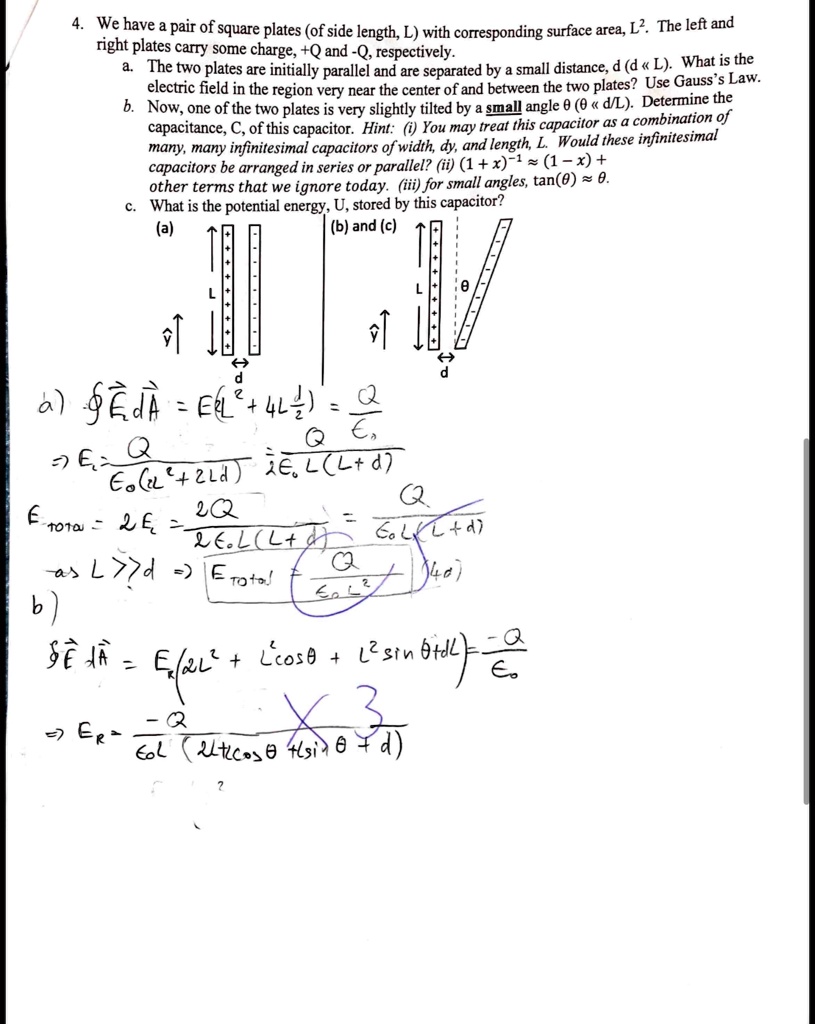
4. We have a pair of square plates (of side length, L) with corresponding surface area, L². The left and
right plates carry some charge, +Q and -Q, respectively.
a. The two plates are initially parallel and are separated by a small distance, d (d < L). What is the
electric field in the region very near the center of and between the two plates? Use Gauss's Law.
b. Now, one of the two plates is very slightly tilted by a small angle 0 (0 < d/L). Determine the
capacitance, C, of this capacitor. Hint: (i) You may treat this capacitor as a combination of
many, many infinitesimal capacitors of width, dy, and length, L. Would these infinitesimal
capacitors be arranged in series or parallel? (ii) (1+x)-¹ ≈ (1-x) +
other terms that we ignore today. (iii) for small angles, tan(0) ≈ 0.
c. What is the potential energy, U, stored by this capacitor?
(a)
(b) and (c)
$$ \oint \vec{E} \cdot d\vec{A} = E(L^2 + 4L) = \frac{Q}{\epsilon_o}$$
$$ \Rightarrow E = \frac{Q}{\epsilon_o(L^2 + 2Ld)} \Rightarrow \vec{E} = \frac{Q}{\epsilon_oL(L+d)} $$
$$ E_{total} = 2E = \frac{2Q}{\epsilon_oL(L+d)} = \frac{Q}{\epsilon_oL(L+d)} $$
$$ as \ L >> d \Rightarrow E_{total} \approx \frac{Q}{\epsilon_oL^2} (40) $$
$$ \oint \vec{E} \cdot d\vec{A} = E(2L^2 + Lcos\theta + L^2sin\theta dl) = \frac{-Q}{\epsilon_o} $$
$$ \Rightarrow E_R = \frac{-Q}{\epsilon_oL(2L+cos\theta + sin\theta + d)} $$