Magnetic field: defined by considering the magnetic force \( \vec{F}_{B} \) experienced by a clarged particle moving with a velocity, \( \vec{v} \).
Assume (for now) there are no gravitational or mectric fields persent.
The magnetic field at soune point in space can be defined in terno of the magnetic force, \( \vec{F}_{B} \) experienoed by a test charged particle moving with welocity \( \overrightarrow{\mathrm{p}} \).
Thus, we will converge on the following relation for the magnitude of the inagnetic force on a charged object:
\[
\overrightarrow{F_{B}}=q \vec{v} \times \vec{B}
\]
From ciur dscussion of cross prodact we know that \( \overrightarrow{4} \times \vec{b}=|a||b| \) sin \( \theta \). It follows that the magnitude of magnetic force is given by
\[
\left|\overrightarrow{F_{B}}\right|=q|\vec{\nabla}||\vec{B}| \sin \theta
\]
or, turnesi around, allows as to define the magnitude of the magnetic field as
\[
|\vec{B}|=\frac{\left|\overrightarrow{F_{B}}\right|}{q|\vec{v}| \sin \theta}
\]
where \( \theta \) is the angle betwerin the velocity, \( \vec{v} \), and the magnetic fiell, \( \vec{B} \).
the resulting vertor is always pointing in a direction perpendicular to the plane formed by \( \overrightarrow{F_{B}} \) and \( \overrightarrow{\mathrm{t}} \), The units of the magnetic fleld ate \( \frac{N}{C^{3}}=\frac{N}{\frac{C}{N}}=\frac{N}{A-m}=T=1= \) Tesla A nom-SI magnetic-field unit in commont use, called the ganss (G), is relatexl to the texkla through the conversion i \( T=10^{4} G \).
1.4 Direction of the Magnetic Field
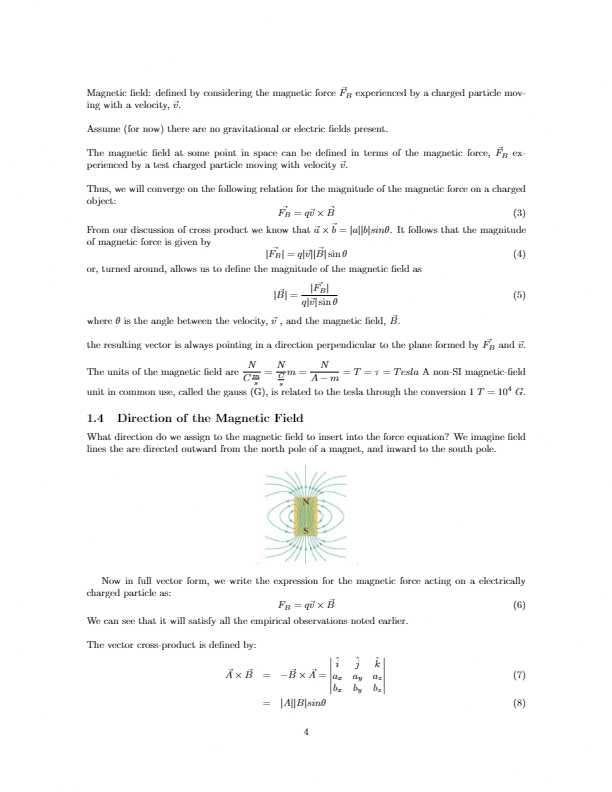
What dirextion do we assign to the magnestic field to itsert into the force equation? We imagine field lines the are dirceted outwand from the porth pole of a magnet, and inward to the south pole
Now in Tull vector form, we write the expression for the magnetic force acting on a electrically charged particle as:
\[
F_{B}=q \vec{v} \times \vec{B}
\]
We can seet that it will satisfy all the empirical obeervatione noted earlier.
The vectot croes-product is defined by:
\[
\begin{aligned}
\vec{A} \times \vec{B} & =-\vec{B} \times \vec{A}=\left|\begin{array}{ccc}
\hat{i} & \hat{j} & \dot{k} \\
a_{z} & a_{y} & a_{z} \\
b_{x} & b_{y} & b_{x}
\end{array}\right| \\
& =|A||B| \sin \theta
\end{aligned}
\]
4