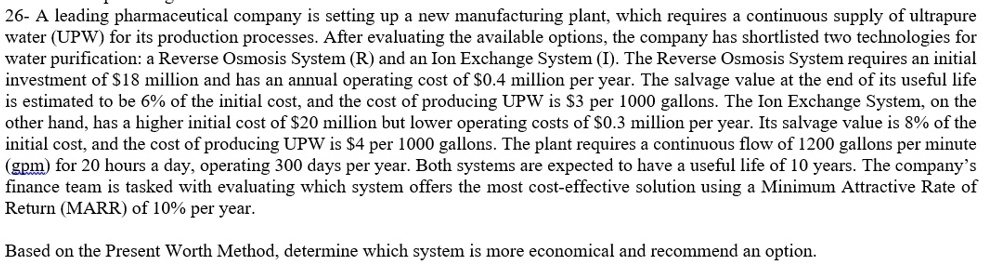
26- A leading pharmaceutical company is setting up a new manufacturing plant, which requires a continuous supply of ultrapure water (UPW) for its production processes. After evaluating the available options, the company has shortlisted two technologies for water purification: a Reverse Osmosis System (R) and an Ion Exchange System (I). The Reverse Osmosis System requires an initial investment of $18 million and has an annual operating cost of $0.4 million per year. The salvage value at the end of its useful life is estimated to be 6% of the initial cost, and the cost of producing UPW is $3 per 1000 gallons. The Ion Exchange System, on the other hand, has a higher initial cost of $20 million but lower operating costs of $0.3 million per year. Its salvage value is 8% of the initial cost, and the cost of producing UPW is $4 per 1000 gallons. The plant requires a continuous flow of 1200 gallons per minute (gpm) for 20 hours a day, operating 300 days per year. Both systems are expected to have a useful life of 10 years. The company's finance team is tasked with evaluating which system offers the most cost-effective solution using a Minimum Attractive Rate of Return (MARR) of 10% per year.
Based on the Present Worth Method, determine which system is more economical and recommend an option.