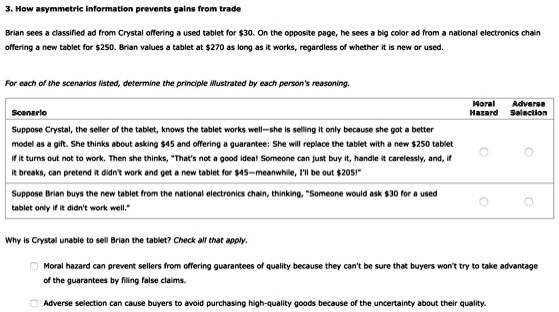
3. How asymmetric information prevents gains from trade
Brian sees a classified ad from Crystal offering a used tablet for $30. On the opposite page, he sees a big color ad from a national electronics chain
offering a new tablet for $250. Brian values a tablet at $270 as long as it works, regardless of whether it is new or used.
For each of the scenarios listed, determine the principle illustrated by each person's reasoning.
Scenario
Suppose Crystal, the seller of the tablet, knows the tablet works well-she is selling it only because she got a better
model as a gift. She thinks about asking $45 and offering a guarantee: She will replace the tablet with a new $250 tablet
if it turns out not to work. Then she thinks, "That's not a good idea! Someone can just buy it, handle it carelessly, and, if
it breaks, can pretend it didn't work and get a new tablet for $45-meanwhile, I'll be out $205!"
Suppose Brian buys the new tablet from the national electronics chain, thinking, "Someone would ask $30 for a used
tablet only if it didn't work well."
Why is Crystal unable to sell Brian the tablet? Check all that apply.
Moral Adversa
Hazard Salaction
Moral hazard can prevent sellers from offering guarantees of quality because they can't be sure that buyers won't try to take advantage
of the guarantees by filing false claims.
Adverse selection can cause buyers to avoid purchasing high-quality goods because of the uncertainty about their quality.