1. Individual Problems 1-1
The owners of a small manufacturing concern have hired a vice president to run the company with the expectation that he will buy the company after
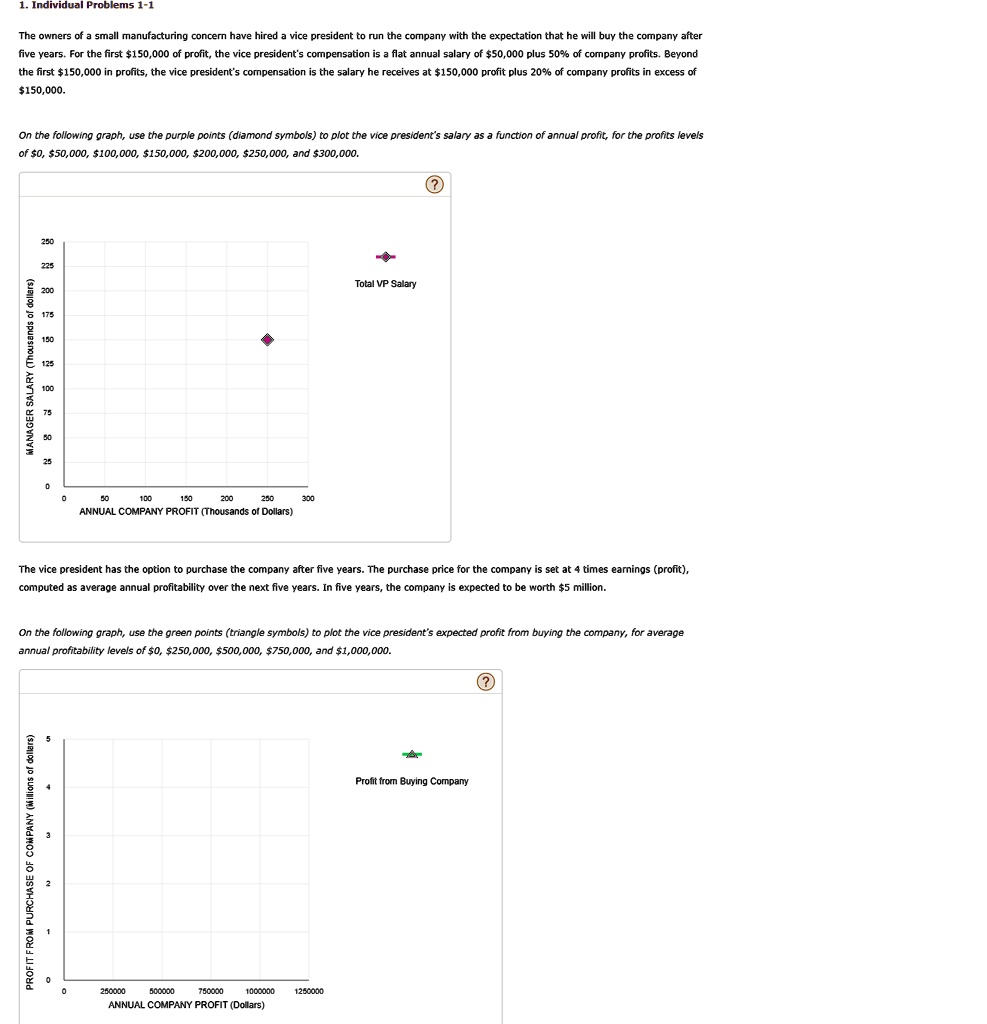
five years. For the first $150,000 of profit, the vice president's compensation is a flat annual salary of $50,000 plus 50% of company profits. Beyond
the first $150,000 in profits, the vice president's compensation is the salary he receives at $150,000 profit plus 20% of company profits in excess of
$150,000.
On the following graph, use the purple points (diamond symbols) to plot the vice president's salary as a function of annual profit, for the profits levels
of $0, $50,000, $100,000, $150,000, $200,000, $250,000, and $300,000.
MANAGER SALARY (Thousands of dollars)
250
200
150
100
50
0
0
50
100
150
200
250
300
ANNUAL COMPANY PROFIT (Thousands of Dollars)
Total VP Salary
The vice president has the option to purchase the company after five years. The purchase price for the company is set at 4 times earnings (profit),
computed as average annual profitability over the next five years. In five years, the company is expected to be worth $5 million.
On the following graph, use the green points (triangle symbols) to plot the vice president's expected profit from buying the company, for average
annual profitability levels of $0, $250,000, $500,000, $750,000, and $1,000,000.
PROFIT FROM PURCHASE OF COMPANY (Millions of dollars)
5
4
3
2
1
0
0
250000
500000
750000 1000000
1250000
ANNUAL COMPANY PROFIT (Dollars)
Profit from Buying Company