Ace - AI Tutor
Ask Our Educators
Textbooks
My Library
Flashcards
Scribe - AI Notes
Notes & Exams
Download App
matthew murphy

matthew m.

Divider

Questions asked

BEST MATCH

the winner of a lottery chooses to receive annual payments of $170,000 at the end of each year for 25 years. if the current interest rate is 4.8% find the present value

View Answer
divider
BEST MATCH

What is the waiting period for handguns and long guns in the state of Florida

View Answer
divider
BEST MATCH

If you run a query that shows all customers who have spent more than $500 over the past six months and limit the results to those who were born in the current month, this would be an example of ________.(1 point) information knowledge data a complex query

View Answer
divider
BEST MATCH

2. Derive the basic accelerator model. How does the logic of the model relate to Keynesian investment theory? (25)

View Answer
divider
BEST MATCH

Find the general solution of the differential equation: y' + 3y = te$^{-4t}$ The solution y(t) is given by the following expression: y(t) = Note: Use lower case c for the constant in your answer.

View Answer
divider
BEST MATCH

26. The power consumed by a 2.2 k\Omega resistor is 240 mW. What is the current level through the resistor?

View Answer
divider
BEST MATCH

MC Qu. 214 If a firm's revenues just cover... If a firm's revenues just cover all its implicit costs, then Multiple Choice normal profit is zero. economic profit is zero. total revenues equal its explicit costs. total revenues equal its implicit costs

View Answer
divider
BEST MATCH

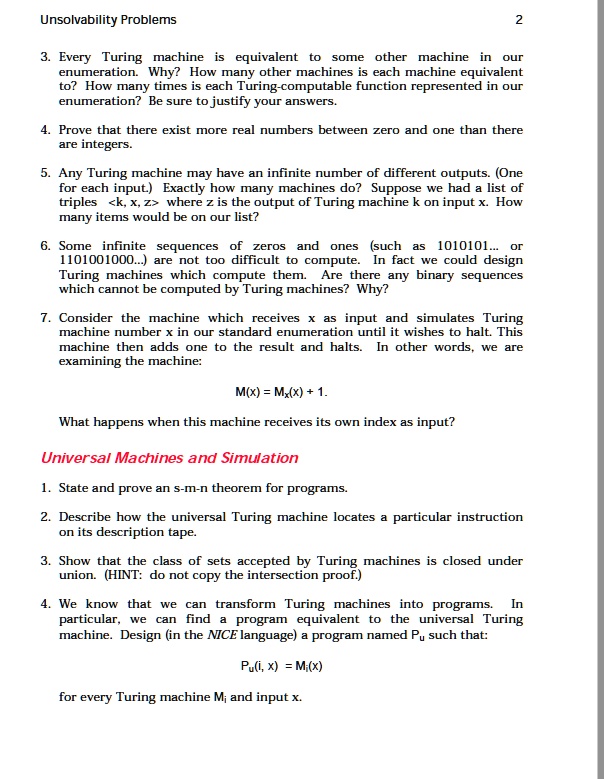
Unsolvability Problems Every Turing machine is equivalent to some other machine in our enumeration. Why? How many other machines is each machine equivalent to? How many times is each Turing-computable function represented in our enumeration? Be sure to justify your answers. Prove that there exist more real numbers between zero and one than there are integers. Any Turing machine may have an infinite number of different outputs. (One for each input.) Exactly how many machines do? Suppose we had a list of triples <k, x, z> where z is the output of Turing machine k on input x. How many items would be on our list? Some infinite sequences of zeros and ones (such as 1010101... or 1101001000...) are not too difficult to compute. In fact, we could design Turing machines which compute them. Are there any binary sequences which cannot be computed by Turing machines? Why? Consider the machine which receives x as input and simulates Turing machine number x in our standard enumeration until it wishes to halt. This machine then adds one to the result and halts. In other words, we are examining the machine: M(x) = Mx(x) + 1. What happens when this machine receives its own index as input? Universal Machines and Simulation State and prove an s-m-n theorem for programs. Describe how the universal Turing machine locates a particular instruction on its description tape. Show that the class of sets accepted by Turing machines is closed under union. (HINT: do not copy the intersection proof.) We know that we can transform Turing machines into programs. In particular, we can find a program equivalent to the universal Turing machine. Design (in the NICE language) a program named P such that: Pu(i, x) = Mi(x) for every Turing machine M and input x.
View Answer
divider
BEST MATCH

Q1- Using the building $Y_{bus}$ matrix procedure, determine $Y_{bus}$ for the circuit shown in the Fig.1. Assume there is no mutual coupling between any of the branches. j1.0 elle 10.4 0000 0.5 0000 0.25 j0.125 0000 + 3 + 1.10$\angle 0^\circ$ Fig. 1 j0.5 0000 10.2 ? j1.25 + 0.90$\angle -30^\circ$ Q2- Now, Using the same Admittance Matrix created in Q1 remove the branch 2-5 and find the new Y-bus Q3- Now, Using the same Admittance Matrix created in Q1 remove Bus-2, find the new Y-bus Q4- Consider that the two branches 1-3 and 2-3 in the circuit Fig. 1 are mutually coupled as inindicated by the dots beside them and that their mutual impedance is j0.15. Determine the circuit $Y_{bus}$.

View Answer
divider
BEST MATCH

1. (20 points) Suppose that A, B, and C are regular sets. $A \downarrow B$ is the nor operator. $A \downarrow B \downarrow C$ is defined as $A \downarrow B \downarrow C = \{x \mid x \text{ is in neither A nor B nor C}\}$ (a) Using logical operations, show that $A \downarrow B \downarrow C$ is a regular set. (b) By constructing a machine M that accepts $A \downarrow B \downarrow C$ when A, B, and C are regular sets, show that $A \downarrow B \downarrow C$ is a regular set. (Hint: Think about the machine that we constructed to show that the family of regular sets is closed under set intersection.)

View Answer
divider