Ace - AI Tutor
Ask Our Educators
Textbooks
My Library
Flashcards
Scribe - AI Notes
Notes & Exams
Download App
matthew parks

matthew p.

Divider

Questions asked

BEST MATCH

1. (33pt) Suppose we know $$\mathcal{L}(\cos kt) = \frac{s}{s^2 + k^2}$$ $$\mathcal{L}(e^{at}f) = \mathcal{L}(f)|_{s-a} \quad \text{(first translation theorem)}$$ $$\mathcal{L}(f(t-a)\mathcal{U}(t-a)) = e^{-as}\mathcal{L}(f) \quad \text{(second translation theorem)}$$ $$\mathcal{U}(t-a) = \begin{cases} 0, & 0 \le t < a \\ 1, & t \ge a \end{cases}$$ Use these formulas to compute $$\mathcal{L}^{-1}\left(\frac{(s-1)e^{-2s}}{(s-1)^2 + 4}\right)$$

View Answer
divider
BEST MATCH

What are some of the financial benefits of being an academic facility rather than a not-for-profit facility? Add in-text citations for attributes with matching references

View Answer
divider
BEST MATCH

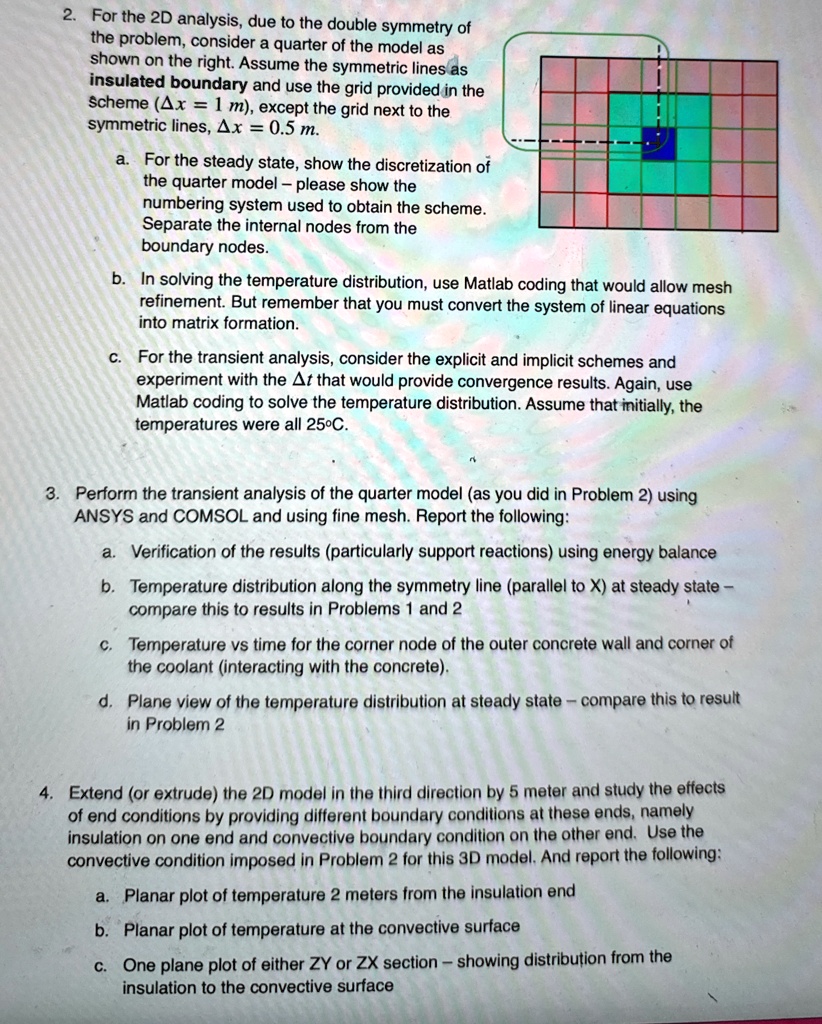
2. For the 2D analysis, due to the double symmetry of the problem, consider a quarter of the model as shown on the right. Assume the symmetric lines as insulated boundary and use the grid provided in the Scheme ($\Delta x = 1$ m), except the grid next to the symmetric lines, $\Delta x = 0.5$ m. a. For the steady state, show the discretization of the quarter model - please show the numbering system used to obtain the scheme. Separate the internal nodes from the boundary nodes. b. In solving the temperature distribution, use Matlab coding that would allow mesh refinement. But remember that you must convert the system of linear equations into matrix formation. c. For the transient analysis, consider the explicit and implicit schemes and experiment with the $\Delta t$ that would provide convergence results. Again, use Matlab coding to solve the temperature distribution. Assume that initially, the temperatures were all 25°C. 3. Perform the transient analysis of the quarter model (as you did in Problem 2) using ANSYS and COMSOL and using fine mesh. Report the following: a. Verification of the results (particularly support reactions) using energy balance b. Temperature distribution along the symmetry line (parallel to X) at steady state - compare this to results in Problems 1 and 2 c. Temperature vs time for the corner node of the outer concrete wall and corner of the coolant (interacting with the concrete). d. Plane view of the temperature distribution at steady state - compare this to result in Problem 2 4. Extend (or extrude) the 2D model in the third direction by 5 meter and study the effects of end conditions by providing different boundary conditions at these ends, namely insulation on one end and convective boundary condition on the other end. Use the convective condition imposed in Problem 2 for this 3D model. And report the following: a. Planar plot of temperature 2 meters from the insulation end b. Planar plot of temperature at the convective surface c. One plane plot of either ZY or ZX section - showing distribution from the insulation to the convective surface
View Answer
divider
BEST MATCH

BE12.5 (LO 2), AP Nabb & Fry Co. reports net income of $31,000. Interest allowances are Nabb $7,000 and Fry $5,000, salary allowances are Nabb $15,000 and Fry $10,000, and the remainder is shared equally. Show the distribution of income. Journalize final cash distribution in liquidation.

View Answer
divider
BEST MATCH

Question 3 (6 points) Sparky D Dragon takes the elevator to the sky deck at the Willis Tower. Suppose Sparky's height above ground for the first 18 seconds is given by the function $f(t) = (1 + \frac{t}{4})^2$ measured in meters, where t is time measured in seconds. Find Sparky's average vertical velocity in m/s between the following val- ues for t. Show all your work! a) (1 point) t = 8 and t = 16 seconds. b) (1 point) t = 8 and t = 12 seconds. c) (3 points) t = 8 and t = 8 + h seconds. Simplify your answer as much as you can! Also, double check that your answer is consistent with part (a) where h = 8 and part (b) where h = 4. d) (1 point) What is the instantaneous velocity at t = 8 seconds? Do this by finding the limit as $h \to 0$ of the average velocity that you found in part (c).

View Answer
divider
BEST MATCH

In which of the following markets are technological advances least likely? a. Perfect competition b. Monopoly c. Oligopoly d. Monopolistic competition

View Answer
divider
BEST MATCH

On the worksheet, make cell A1 the active cell and then simultaneously replace all occurrences of the text Amount with the text Price. Close any open dialog boxes.

View Answer
divider
BEST MATCH

a $1000, 7.1% coupon bond has 19 1/2 years remaining until maturity calculate upon discount if the required to turn in the open market is 8.2% compounded semi annually bond discount: $

View Answer
divider
BEST MATCH

The \"Freshman 15\" refers to the belief that college students gain 15 lb (or 6.8 kg) during their freshman year. Listed in the accompanying table are weights (kg) of randomly selected male college freshmen. The weights were measured in September and later in April. Use the listed paired sample data, and assume that the samples are simple random samples and that the differences have a distribution that is approximately normal. Complete parts (a) through (c). September 50 92 87 68 54 59 64 52 94 April 47 92 88 69 56 62 68 57 105 a. Use a 0.01 significance level to test the claim that for the population of freshman male college students, the weights in September are less than the weights in the following April. In this example, $\mu_d$ is the mean value of the differences d for the population of all pairs of data, where each individual difference d is defined as the April weight minus the September weight. What are the null and alternative hypotheses for the hypothesis test? $H_0: \mu_d$ kg $H_1: \mu_d$ kg (Type integers or decimals. Do not round.)

View Answer
divider
BEST MATCH

Choose test values and indicate whether the inequality is true or false in each region. Test Value Inequality Select an answer * Select an answer Select an answer ~ Write the solution as a compound inequality and draw the solution

View Answer
divider