Chapter 2: Control Theory Basics
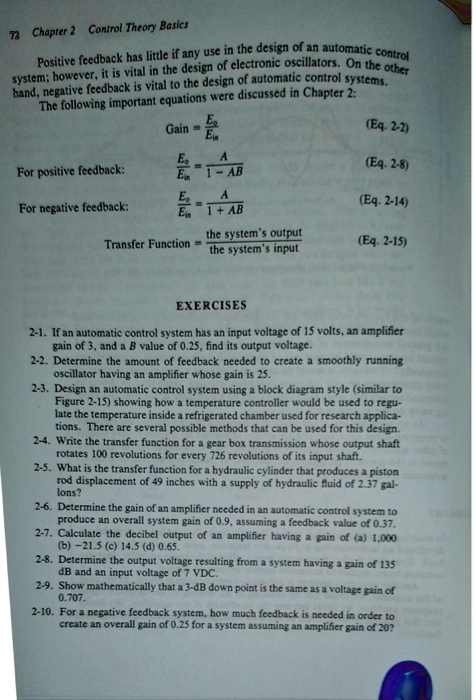
Gain = E Ein
(Eq. 2-2)
A
(Eq. 2-8)
For positive feedback:
A
(Eq. 2-14)
For negative feedback:
En the system's output Transfer Function = - the system's input
(Eq. 2-15)
EXERCISES
2-1. If an automatic control system has an input voltage of 15 volts, an amplifier gain of 3, and a B value of 0.25, find its output voltage.
2-2. Determine the amount of feedback needed to create a smoothly running oscillator having an amplifier whose gain is 25.
2-3. Design an automatic control system using a block diagram style (similar to Figure 2-15) showing how a temperature controller would be used to regulate the temperature inside a refrigerated chamber used for research applications. There are several possible methods that can be used for this design.
2-4. Write the transfer function for a gear box transmission whose output shaft rotates 100 revolutions for every 726 revolutions of its input shaft.
2-5. What is the transfer function for a hydraulic cylinder that produces a piston rod displacement of 49 inches with a supply of hydraulic fluid of 2.37 gallons?
2-6. Determine the gain of an amplifier needed in an automatic control system to produce an overall system gain of 0.9, assuming a feedback value of 0.37.
2-7. Calculate the decibel output of an amplifier having a gain of 1,000.
2-8. Determine the output voltage resulting from a system having a gain of 135 dB and an input voltage of 7 VDC.
2-9. Show mathematically that a 3-dB down point is the same as a voltage gain of 0.707.
2-10. For a negative feedback system, how much feedback is needed in order to...