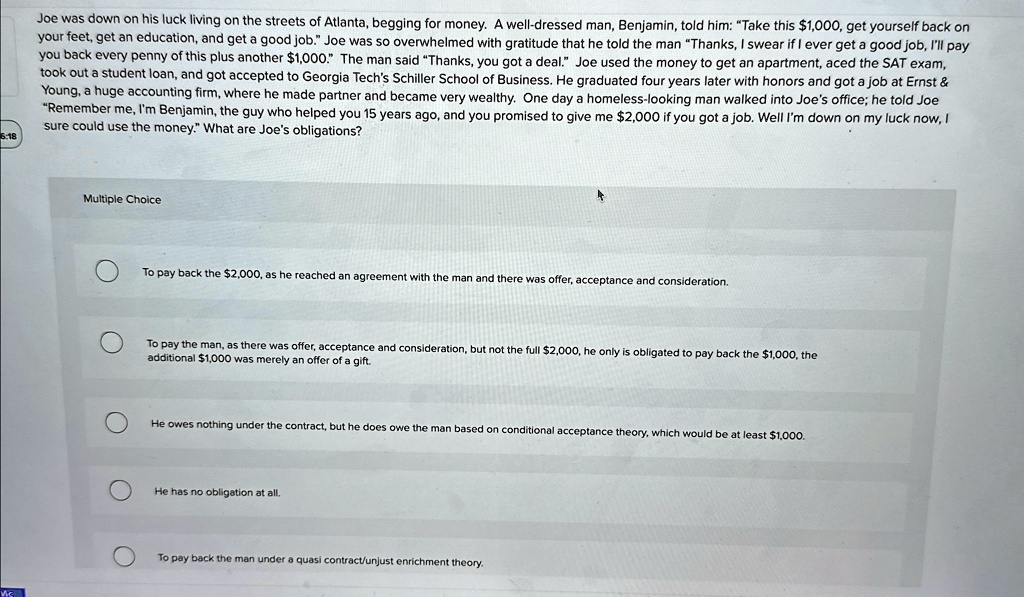
Joe was down on his luck living on the streets of Atlanta, begging for money. A well-dressed man, Benjamin, told him: "Take this $1,000, get yourself back on your feet, get an education, and get a good job." Joe was so overwhelmed with gratitude that he told the man "Thanks, I swear if I ever get a good job, I'll pay you back every penny of this plus another $1,000." The man said "Thanks, you got a deal." Joe used the money to get an apartment, aced the SAT exam, took out a student loan, and got accepted to Georgia Tech's Schiller School of Business. He graduated four years later with honors and got a job at Ernst & Young, a huge accounting firm, where he made partner and became very wealthy. One day a homeless-looking man walked into Joe's office; he told Joe "Remember me, I'm Benjamin, the guy who helped you 15 years ago, and you promised to give me $2,000 if you got a job. Well I'm down on my luck now, I sure could use the money." What are Joe's obligations?
Multiple Choice
To pay back the $2,000, as he reached an agreement with the man and there was offer, acceptance and consideration.
To pay the man, as there was offer, acceptance and consideration, but not the full $2,000, he only is obligated to pay back the $1,000, the additional $1,000 was merely an offer of a gift.
He owes nothing under the contract, but he does owe the man based on conditional acceptance theory, which would be at least $1,000.
He has no obligation at all.
To pay back the man under a quasi contract/unjust enrichment theory.