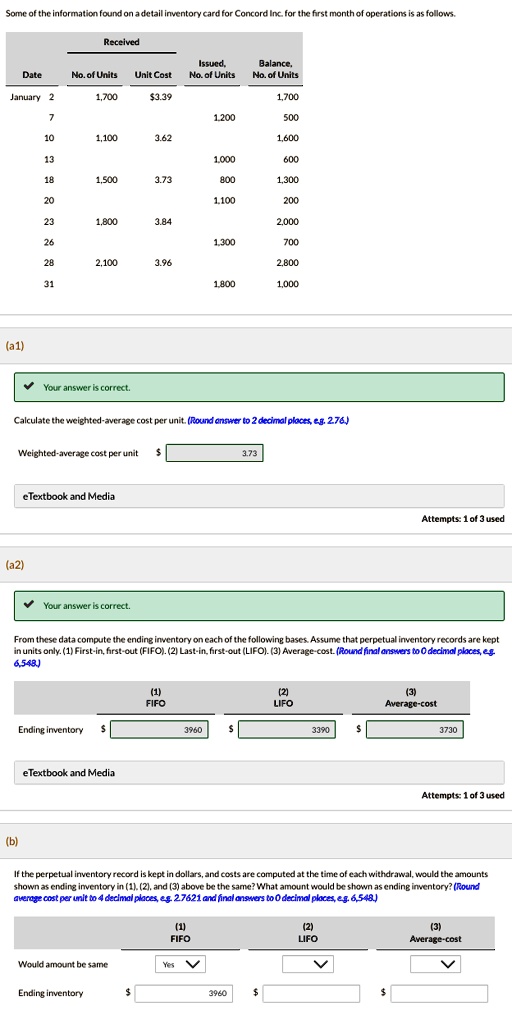
Some of the information found on a detail inventory card for Concord Inc. for the first month of operations is as follows.
Received
Date
No. of Units
Unit Cost
Issued,
No. of Units
Balance,
No. of Units
January 2
1,700
$3.39
1,700
7
1,200
500
10
1,100
3.62
1,600
13
1,000
600
18
1,500
3.73
800
1,300
20
1,100
200
23
1,800
3.84
2,000
26
1,300
700
28
2,100
3.96
2,800
31
1,800
1,000
(a1)
?Your answer is correct.
Calculate the weighted-average cost per unit. (Round answer to 2 decimal places, e.g. 2.76.)
Weighted-average cost per unit
$
3.73
eTextbook and Media
Attempts: 1 of 3 used
(a2)
?Your answer is correct.
From these data compute the ending inventory on each of the following bases. Assume that perpetual inventory records are kept
in units only. (1) First-in, first-out (FIFO). (2) Last-in, first-out (LIFO). (3) Average-cost. (Round final answers to 0 decimal places, e.g.
6,548)
(1)
FIFO
Ending inventory
$
3960
(2)
LIFO
3390
(3)
Average-cost
3730
eTextbook and Media
Attempts: 1 of 3 used
(b)
If the perpetual inventory record is kept in dollars, and costs are computed at the time of each withdrawal, would the amounts
shown as ending inventory in (1), (2), and (3) above be the same? What amount would be shown as ending inventory? (Round
average cost per unit to 4 decimal places, e.g. 2.7621 and final answers to 0 decimal places, e.g. 6,548)
(1)
FIFO
Would amount be same
Yes
Ending inventory
$
3960
(2)
LIFO
(3)
Average-cost