Newton's resolution of the system given by the Lagrange multipliers
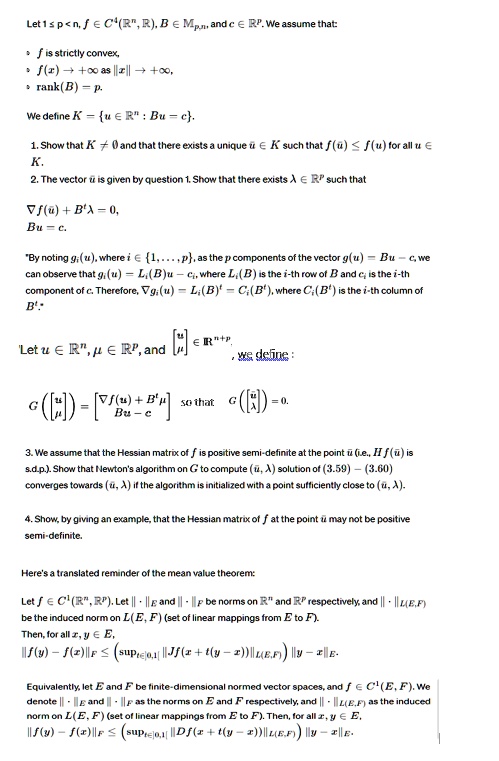
Let 1 p < n, f C4R, R, BMp, n and c RP. We assume that:
f is strictly convex, f+ as ||+, rank B = p.
We define K = { R: Bu = c}
1. Show that K and that there exists a unique K such that f(u) for all u K.
2. The vector is given by question 1. Show that there exists RP such that 0 = X + Bu = c. By noting g, where i {1.., p}, as the p components of the vector g() = Bu - c, we can observe that g = LBu - c, where LB is the i-th row of B and c is the i-th component of c. Therefore, Vg) = LB = C; Bf), where C; Bf) is the i-th column of Bt.
R+ Let ER ER P, and [] we define = [fB so that c(] = Bu - c
3. We assume that the Hessian matrix of f is positive semi-definite at the point u (i.e., II f () is s.d.p.). Show that Newton's algorithm on G to compute (, ) solution of (3.59) (3.60) converges towards (, ) if the algorithm is initialized with a point sufficiently close to (, ).
4. Show, by giving an example, that the Hessian matrix of f at the point may not be positive semi-definite.
Here's a translated reminder of the mean value theorem:
Let C R RP. Let |E and | - | be norms on R and RP respectively and ||EF) be the induced norm on (E, F) (set of linear mappings from E to F). Then, for all , y E, |f(y)f|Fsupro, |Jfx+ty |E, F|y-xE
Equivalently, let E and F be finite-dimensional normed vector spaces, and f C(E, F), We denote | - and | - ||F as the norms on E and F respectively, and | - [|(E, F) as the induced norm on (E, F) (set of linear mappings from E to F). Then, for all , y E, l|f(y)f(x)|F (suptco, 1l|Df( + t(y))||z(E, F) I|y|