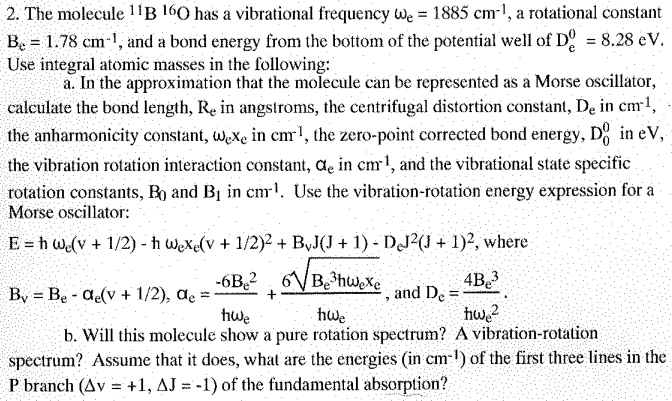
2. The molecule $^{11}B$ $^{16}O$ has a vibrational frequency $\omega_e$ = 1885 cm$^{-1}$, a rotational constant
$B_e$ = 1.78 cm$^{-1}$, and a bond energy from the bottom of the potential well of $D_e^0$ = 8.28 eV.
Use integral atomic masses in the following:
a. In the approximation that the molecule can be represented as a Morse oscillator,
calculate the bond length, $R_e$ in angstroms, the centrifugal distortion constant, $D_e$ in cm$^{-1}$,
the anharmonicity constant, $\omega_e x_e$ in cm$^{-1}$, the zero-point corrected bond energy, $D_0^0$ in eV,
the vibration rotation interaction constant, $\alpha_e$ in cm$^{-1}$, and the vibrational state specific
rotation constants, $B_0$ and $B_1$ in cm$^{-1}$. Use the vibration-rotation energy expression for a
Morse oscillator:
$E = h\omega_e(v + 1/2) - h\omega_e x_e(v + 1/2)^2 + B_v J(J + 1) - D_e J^2(J + 1)^2$, where
$B_v = B_e - \alpha_e(v + 1/2)$, $\alpha_e = \frac{-6B_e^2}{h\omega_e} + \frac{6\sqrt{B_e^3 h\omega_e x_e}}{h\omega_e}$, and $D_e = \frac{4B_e^3}{h\omega_e^2}$.
b. Will this molecule show a pure rotation spectrum? A vibration-rotation
spectrum? Assume that it does, what are the energies (in cm$^{-1}$) of the first three lines in the
P branch ($\Delta v$ = +1, $\Delta J$ = -1) of the fundamental absorption?