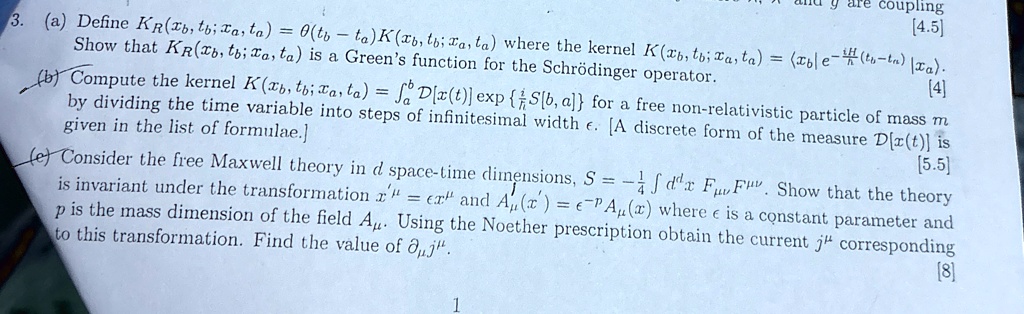
3. (a) Define $K_R(x_b, t_b; x_a, t_a) = \theta(t_b - t_a)K(x_b, t_b; x_a, t_a)$ where the kernel $K(x_b, t_b; x_a, t_a) = \langle x_b | e^{-\frac{i}{\hbar}(t_b - t_a)H} | x_a \rangle$.
Show that $K_R(x_b, t_b; x_a, t_a)$ is a Green's function for the Schrödinger operator.
[4.5]
(b) Compute the kernel $K(x_b, t_b; x_a, t_a) = \int_a^b D[x(t)] \exp\{\frac{i}{\hbar}S[b, a]\}$ for a free non-relativistic particle of mass $m$
by dividing the time variable into steps of infinitesimal width $\epsilon$. [A discrete form of the measure $D[x(t)]$ is
given in the list of formulae.]
[4]
(e) Consider the free Maxwell theory in $d$ space-time dimensions, $S = -\frac{1}{4}\int d^d x F_{\mu\nu}F^{\mu\nu}$. Show that the theory
is invariant under the transformation $x'^\mu = \epsilon^p x^\mu$ and $A_\mu(x') = \epsilon^{-p}A_\mu(x)$ where $\epsilon$ is a constant parameter and
$p$ is the mass dimension of the field $A_\mu$. Using the Noether prescription obtain the current $j^\mu$ corresponding
to this transformation. Find the value of $\partial_\mu j^\mu$.
[5.5]
[8]