PROBLEM 2 - Mulliken System in C2 Molecule
The aim of this problem is to study the so-called Mulliken system in C2 molecule, i.e. an electronic transition corresponding to an electrical dipolar transition between the D excited state and the x ground state.
Ground STATE ELECTRONIC CONFIGURATION: Give the ground state electronic configuration and its degeneracy for C2 molecule (Carbon: Z=6, A=12). For diatomic homonuclear molecule, the filling order for molecular orbitals is given by:
σg1s < σu1s < σg2s < σu2s < πu2p < σg2p < πg2p < σu2p
Molecular TERM: Determine the molecular term associated with the ground state electronic configuration. This molecular term is labeled X. Use the spectroscopic notation and explain the quantum numbers used.
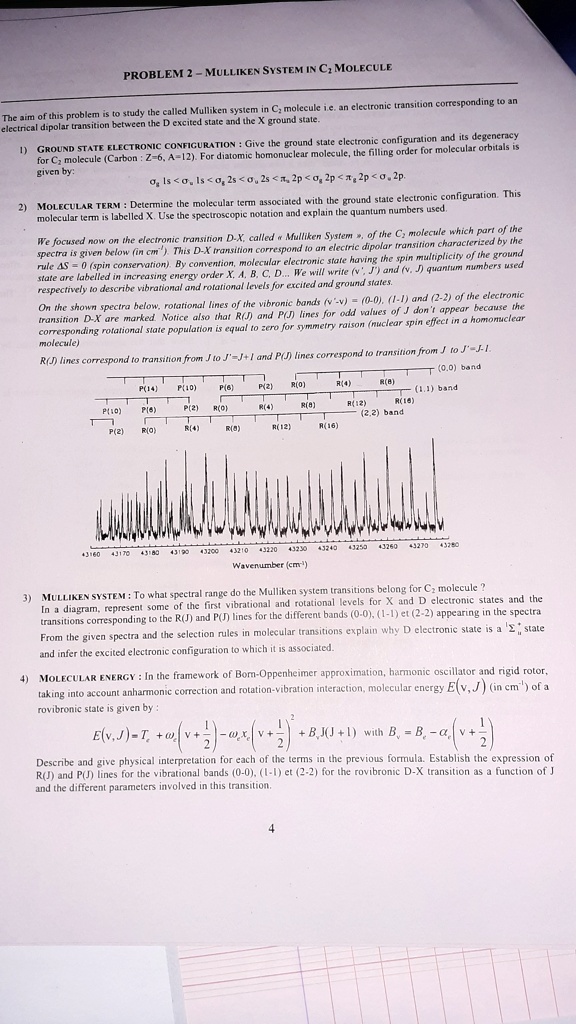
We focus now on the electronic transition D-X, called "Mulliken System", of the C2 molecule which part of the spectra is given below (in cm^(-1)). This D - x transition corresponds to an electric dipolar transition characterized by the rule ΔS=0 (spin conservation). By convention, molecular electronic states having the spin multiplicity of the ground state are labeled in increasing energy order x, A, B, C, D, etc. We will write (v^('), J^(')) and (v, J) quantum numbers used respectively to describe vibrational and rotational levels for excited and ground states.
On the shown spectra below, rotational lines of the vibronic bands (v^(')-v) = (0-0), (1-1), and (2-2) of the electronic transition D-X are marked. Notice also that R(J) and P(J) lines for odd values of J don't appear because the corresponding rotational state population is equal to zero for symmetry reasons (nuclear spin effect in a homonuclear molecule).
R(J) lines correspond to transition from J to J^(') = J+I and P(J) lines correspond to transition from J to J^(') = J-1.
Mulliken SYSTEM: To what spectral range do the Mulliken system transitions belong for C2 molecule?
In a diagram, represent some of the first vibrational and rotational levels for x and D electronic states and the transitions corresponding to the R(J) and P(J) lines for the different bands (0-0), (1-1), and (2-2) appearing in the spectra.
From the given spectra and the selection rules in molecular transitions, explain why D electronic state is a ^(')Σu^(+) state and infer the excited electronic configuration to which it is associated.
Molecular ENERGY: In the framework of Born-Oppenheimer approximation, harmonic oscillator and rigid rotor, taking into account anharmonic correction and rotation-vibration interaction, molecular energy in cm^(-1) of a rovibronic state is given by:
E(v, J) = Te + ωe(v + (1)/2) - ωexe(v + (1)/2)^(2) + BvJ(J+1) with Bv = Be - αe(v + (1)/2)
Describe and give physical interpretation for each of the terms in the previous formula. Establish the expression of R(J) and P(J) lines for the vibrational bands (0-0), (1-1), and (2-2) for the rovibronic D-X transition as a function of J and the different parameters involved in this transition.