Ace - AI Tutor
Ask Our Educators
Textbooks
My Library
Flashcards
Scribe - AI Notes
Notes & Exams
Download App
megan dixon

megan d.

Divider

Questions asked

BEST MATCH

tools for consolidating analyzing and providing access to vast amounts of data to help users make better

View Answer
divider
BEST MATCH

3. The acid-catalyzed dehydration of 1-methylcyclohexanol yields a mixture of two alkenes. How could you use $^1$H NMR to help you decide which was which? CH$_3$ OH H$_3$O$^+$ CH$_2$ CH$_3$ +

View Answer
divider
BEST MATCH

A term given to normal flora when it relocates to a different area of the body. a. Normal b. Sterile c. Plated d. Transient

View Answer
divider
BEST MATCH

The expected blood type for agglutination of blood with Anti-A antibody A but not with Anti-B antibody would be 1. A 2. B 3. AB 4. C

View Answer
divider
BEST MATCH

Question Completion Status: QUESTION 10 + Positive & Negative In the book and movie "Angels and Demons", charged particles of anti-matter are trapped in a vial, and the vial is hand-carried around to various places. How realistic is this scenario? O It is not currently realistic. It is not likely that a hand-held device would be able to enclose the anti-matter. O It is very realistic. I'm betting that such a device already exists. QUESTION 11 Click Save and Submit to save and submit. Click Save All Answers to save all answers. 75°F Morth FUDDY Q Search 5 points (Exti Save All Answ

View Answer
divider
BEST MATCH

Problem: Use the power series method to solve the given initial value problem: $(x^2 - 1)\frac{d^2y}{dx^2} + 3x\frac{dy}{dx} + xy = 0, y(0) = 4, y'(0) = 6$. (Hint: Assume a power series solution about the ordinary point $x_0 = 0$.)

View Answer
divider
BEST MATCH

if a 5.0 kg object is moving at 0.78c (78% of the speed of light), what is the relativistic momentum of that object

View Answer
divider
BEST MATCH

The elementary and liquid-phase reaction A+B?C+D is carried out isothermally in an ideal reactor system as shown in the figure with $V_0 = 1 m^3/min$, and $C_{A0} = C_{B0} = 2.0 kmol/m^3$. The rate constant is $0.56 m^3/kmol \cdot min^{-1}$. The space time (reactor volume/feed flow rate) of the plug flow reactor and the continuous-stirred tank reactors are $\tau_{PFR} = 2 min$ and $\tau_{CSTR} = 8 min$, respectively. Please determine the conversion of species A at exit the system.

View Answer
divider
BEST MATCH

Q1. Calculate the h value shown on the manometer below. The velocity at point 1 is 1.8 ft/s. Ignore friction losses. ($\rho_{Hg}$ = 845 lbm/ft$^3$, $\rho_{H2O}$ = 62.3 lbm/ft$^3$)

View Answer
divider
BEST MATCH

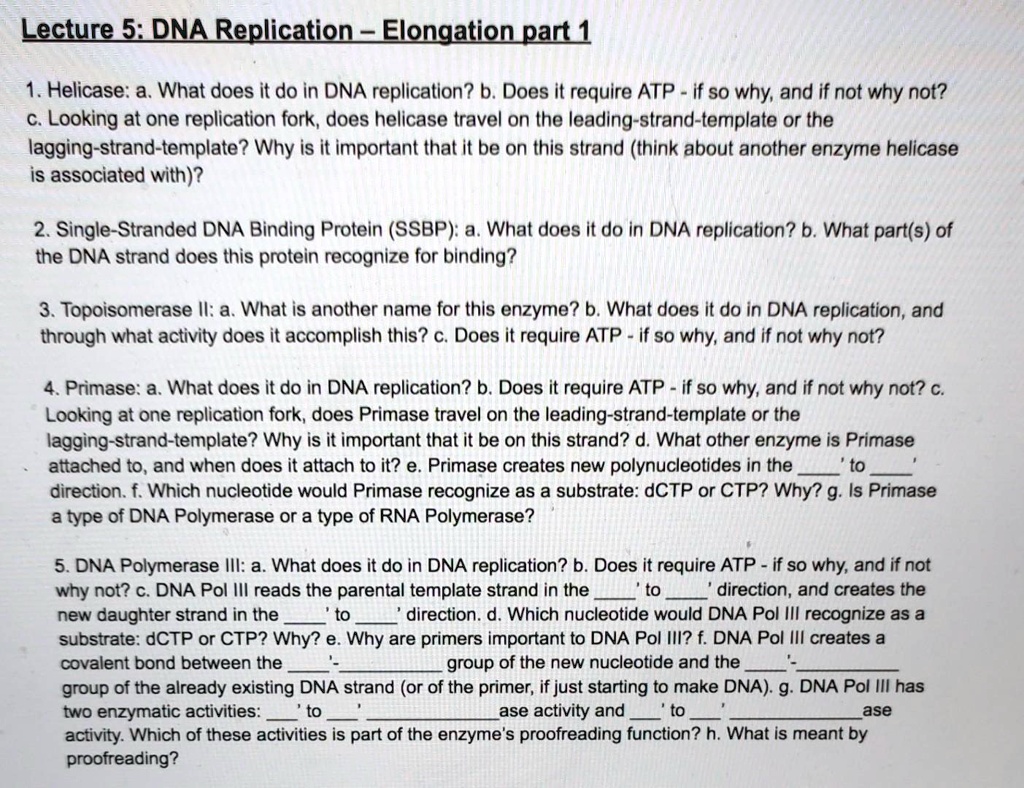
Lecture 5: DNA Replication - Elongation part 1 1. Helicase: a. What does it do in DNA replication? b. Does it require ATP - if so why, and if not why not? c. Looking at one replication fork, does helicase travel on the leading-strand-template or the lagging-strand-template? Why is it important that it be on this strand (think about another enzyme helicase is associated with)? 2. Single-Stranded DNA Binding Protein (SSBP): a. What does it do in DNA replication? b. What part(s) of the DNA strand does this protein recognize for binding? 3. Topoisomerase II: a. What is another name for this enzyme? b. What does it do in DNA replication, and through what activity does it accomplish this? c. Does it require ATP - if so why, and if not why not? 4. Primase: a. What does it do in DNA replication? b. Does it require ATP - if so why, and if not why not? c. Looking at one replication fork, does Primase travel on the leading-strand-template or the lagging-strand-template? Why is it important that it be on this strand? d. What other enzyme is Primase attached to, and when does it attach to it? e. Primase creates new polynucleotides in the ____' to ____' direction. f. Which nucleotide would Primase recognize as a substrate: dCTP or CTP? Why? g. Is Primase a type of DNA Polymerase or a type of RNA Polymerase? 5. DNA Polymerase III: a. What does it do in DNA replication? b. Does it require ATP - if so why, and if not why not? c. DNA Pol III reads the parental template strand in the ____' to ____' direction, and creates the new daughter strand in the ____' to ____' direction. d. Which nucleotide would DNA Pol III recognize as a substrate: dCTP or CTP? Why? e. Why are primers important to DNA Pol III? f. DNA Pol III creates a covalent bond between the ____'-____________ group of the new nucleotide and the ____'-____________ group of the already existing DNA strand (or of the primer, if just starting to make DNA). g. DNA Pol III has two enzymatic activities: ____' to ____' ____________ase activity and ____' to ____' ____________ase activity. Which of these activities is part of the enzyme's proofreading function? h. What is meant by proofreading?
View Answer
divider