Ace - AI Tutor
Ask Our Educators
Textbooks
My Library
Flashcards
Scribe - AI Notes
Notes & Exams
Download App
megan jackson

megan j.

Divider

Questions asked

BEST MATCH

Activity Activity Rate Materials handling $ 51 per materials requisition Quality inspection $ 41 per inspection Utilities $ 5 per machine hour Activity Cost Driver Job A Job B Materials 5 3 requisitions Inspections 8 4 Machine hours 305 205 Allocate overhead based on actual activity usage-Job A Activity Activity Usage Activity Rate Allocated Cost Materials handling Quality inspection Utilities Total Allocate overhead based on actual activity usage-Job B Activity Activity Usage Activity Rate Allocated Cost Materials handling Quality inspection Utilities Total

View Answer
divider
BEST MATCH

\[ \begin{array}{l} \cos \alpha=0.6875 \\ \alpha=46.57^{\circ} \end{array} \] answer

View Answer
divider
BEST MATCH

Finance generally ________. ? records past transactions ? measures the results of a business's past activities ? is forward-looking

View Answer
divider
BEST MATCH

1 point Suppose x and y vary inversely, and x = 4 when y = 9. Which function models the inverse variation? $x = \frac{y}{36}$ $\frac{x}{y} = 36$ $y = \frac{36}{x}$ $y = \frac{x}{36}$

View Answer
divider
BEST MATCH

If the market price in competitive industry is above its equally room level new firms will enter the market true or false

View Answer
divider
BEST MATCH

Your answer is incorrect. There are also equations, known as integro-differential equations, in which both derivatives and integrals of the unknown function appear. Solve the given integro-differential equation by using the Laplace transform: $\phi'(t) - \frac{81}{2} \int_0^t (t - \xi)^2 \phi(\xi) d\xi = -9t$, $\phi(0) = 1$ $\phi(t) = -\frac{9}{4}e^{-3t} - \frac{9}{4}e^{3t} - \frac{9}{2}cos(3t)$

View Answer
divider
BEST MATCH

Text: Use basic logical equivalences to show that ¬(r ∧ (p ∨ q)) → (r ∧ ¬(p ∨ q)) is logically equivalent to r. Write the names of the logical equivalences you are using at each step. Solution: 1. ¬(r ∧ (p ∨ q)) → (r ∧ ¬(p ∨ q)) (Given) 2. ¬(r ∧ (p ∨ q)) → (r ∧ (¬p ∧ ¬q)) (De Morgan's Law) 3. ¬(r ∧ (p ∨ q)) → ¬(¬r ∨ (p ∨ q)) (De Morgan's Law) 4. ¬(r ∧ (p ∨ q)) → ¬(r ∨ (p ∨ q)) (Double Negation) 5. ¬(r ∧ (p ∨ q)) → ¬(r ∨ p ∨ q) (Associative Law) 6. ¬(r ∧ (p ∨ q)) → ¬(p ∨ q ∨ r) (Commutative Law) 7. ¬(r ∧ (p ∨ q)) → ¬(p ∨ (q ∨ r)) (Associative Law) 8. ¬(r ∧ (p ∨ q)) → ¬(p ∨ (r ∨ q)) (Commutative Law) 9. ¬(r ∧ (p ∨ q)) → ¬(p ∨ (r ∧ q)) (Commutative Law) 10. ¬(r ∧ (p ∨ q)) → ¬(p ∨ (q ∧ r)) (Commutative Law) 11. ¬(r ∧ (p ∨ q)) → ¬(p ∨ (q ∧ ¬r)) (Commutative Law) 12. ¬(r ∧ (p ∨ q)) → ¬(p ∨ (¬r ∧ q)) (Commutative Law) 13. ¬(r ∧ (p ∨ q)) → ¬(p ∨ (¬r ∨ q)) (Commutative Law) 14. ¬(r ∧ (p ∨ q)) → ¬((p ∨ ¬r) ∨ q) (Associative Law) 15. ¬(r ∧ (p ∨ q)) → ¬((¬r ∨ p) ∨ q) (Commutative Law) 16. ¬(r ∧ (p ∨ q)) → ¬((¬r ∨ p) ∨ ¬q) (Commutative Law) 17. ¬(r ∧ (p ∨ q)) → ¬((¬r ∨ ¬q) ∨ p) (Commutative Law) 18. ¬(r ∧ (p ∨ q)) → ¬((¬q ∨ ¬r) ∨ p) (Commutative Law) 19. ¬(r ∧ (p ∨ q)) → ¬((¬q ∨ p) ∨ ¬r) (Commutative Law) 20. ¬(r ∧ (p ∨ q)) → ¬((p ∨ ¬q) ∨ ¬r) (Commutative Law) 21. ¬(r ∧ (p ∨ q)) → ¬((p ∨ q) ∨ ¬r) (Commutative Law) 22. ¬(r ∧ (p ∨ q)) → ¬((q ∨ p) ∨ ¬r) (Commutative Law) 23. ¬(r ∧ (p ∨ q)) → ¬((q ∨ ¬p) ∨ ¬r) (Commutative Law) 24. ¬(r ∧ (p ∨ q)) → ¬((¬p ∨ q) ∨ ¬r) (Commutative Law) 25. ¬(r ∧ (p ∨ q)) → ¬((¬p ∨ ¬q) ∨ ¬r) (Commutative Law) 26. ¬(r ∧ (p ∨ q)) → ¬((¬q ∨ ¬p) ∨ ¬r) (Commutative Law) 27. ¬(r ∧ (p ∨ q)) → ¬((¬q ∨ p) ∨ ¬r) (Commutative Law) 28. ¬(r ∧ (p ∨ q)) → ¬((p ∨ ¬q) ∨ ¬r) (Commutative Law) 29. ¬(r ∧ (p ∨ q)) → ¬((p ∨ q) ∨ ¬r) (Commutative Law) 30. ¬(r ∧ (p ∨ q)) → ¬((q ∨ p) ∨ ¬r) (Commutative Law) 31. ¬(r ∧ (p ∨ q)) → ¬((q ∨ ¬p) ∨ ¬r) (Commutative Law) 32. ¬(r ∧ (p ∨ q)) → ¬((¬p ∨ q) ∨ ¬r) (Commutative Law) 33. ¬(r ∧ (p ∨ q)) → ¬((¬p ∨ ¬q) ∨ ¬r) (Commutative Law) 34. ¬(r ∧ (p ∨ q)) → ¬((¬q ∨ ¬p) ∨ ¬r) (Commutative Law) 35. ¬(r ∧ (p ∨ q)) → ¬((¬q ∨ p) ∨ ¬r) (Commutative Law) 36. ¬(r ∧ (p ∨ q)) → ¬((p ∨ ¬q) ∨ ¬r) (Commutative Law) 37. ¬(r ∧ (p ∨ q)) → ¬((p ∨ q) ∨ ¬r) (Commutative Law) 38. ¬(r ∧ (p ∨ q)) → ¬((q ∨ p) ∨ ¬r) (Commutative Law) 39. ¬(r ∧ (p ∨ q)) → ¬((q ∨ ¬p) ∨ ¬r) (Commutative Law) 40. ¬(r ∧ (p ∨ q)) → ¬((¬p ∨ q) ∨ ¬r) (Commutative Law) 41. ¬(r ∧ (p ∨ q)) → ¬((¬p ∨ ¬q) ∨ ¬r) (Commutative Law) 42. ¬(r ∧ (p ∨ q)) → ¬((¬q ∨ ¬p) ∨ ¬r) (Commutative Law) 43. ¬(r ∧ (p ∨ q)) → ¬((¬q ∨ p) ∨ ¬r) (Commutative Law) 44. ¬(r ∧ (p ∨ q)) → ¬((p ∨ ¬q) ∨ ¬r) (Commutative Law) 45. ¬(r ∧ (p ∨ q)) → ¬((p ∨ q) ∨ ¬r) (Commutative Law) 46

View Answer
divider
BEST MATCH

LaunchPad Country A and country B both have the production function Y = F(K, L) = K$^{1/3}$L$^{2/3}$ a. Does this production function have constant returns to scale? Explain. b. What is the per-worker production function, y = f(k)? c. Assume that neither country experiences population growth or technological progress and that 20 percent of capital depreciates each year. Assume further that country A saves 10 percent of output each year and country B saves 30 percent of output each year. Using your answer from part (b) and the steady-state condition that investment equals depreciation, find the steady-state level of capital per work- er for each country. Then find the steady-state levels of income per worker and consumption per worker. Suppose that both countries start off with a capital stock per worker of 1. What are the levels of income per worker and consumption per worker? Remembering that the change in the capital stock is investment less depreciation, use a calculator (or, better yet, a computer spread- sheet) to show how the capital stock per worker will evolve over time in both coun- tries. For each year, calculate income per worker and consumption per worker. How many years will it be before the consumption in country B is higher than the consumption in country A?

View Answer
divider
BEST MATCH

1. Find $r$, $\bar{x}$, $\bar{y}$, $s_x$, $s_y$, $b_0$, and $b_1$ for the following bivariate data sets. Write the regression equation: $\hat{y} = b_0 + b_1x$ and interpret the meaning of each variable in the context of the problem: a) Jose asked 5 family members about their level of education (x) and their salary per hour (y). The results were as follows: (10, 15); (12, 17); (13, 21); (16, 42); (18, 40). b) Michael asked his four cousins about their number of siblings (x) and the number of children each of them have (y). The results were as follows (1, 0); (1, 2); (2, 2); (3, 1). c) Lee asked his four employees about the number of hours they work per day (x) and the number of hours they sleep at night (y). The results were as follows: (5, 9); (5.5, 7); (8, 8); (10, 6) d) Jennifer collected data on the number of spiders (x) and the number of earwigs (y) at 5 of her neighbors backyards. This is the data she collected: (3, 16), (5, 10), (5, 13), (8, 8), (12, 4) e) Mishka collected data on the number of servings of fruits (x) and vegetables (y) that 5 of customers consumed per day. This is the data she collected: (1, 0), (3, 0), (3, 4), (4, 5), (6, 6)

View Answer
divider
BEST MATCH

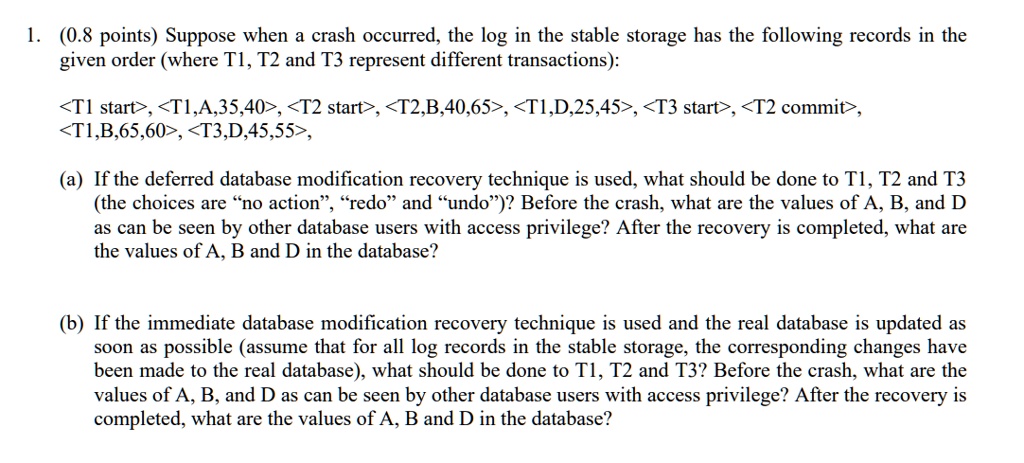
0.8 points Suppose when a crash occurred, the log in the stable storage has the following records in the given order (where T1, T2 and T3 represent different transactions): <T1 start>,<T1,A,35,40>,<T2 start>,<T2,B,40,65>,<T1,D,25,45>,<T3 start>,<T2 commit> <T1,B,65,60>,<T3,D,45,55> (a) If the deferred database modification recovery technique is used, what should be done to T1, T2 and T3 (the choices are no action, redo and undo)? Before the crash, what are the values of A, B, and D as can be seen by other database users with access privilege? After the recovery is completed, what are the values of A, B and D in the database? (b) If the immediate database modification recovery technique is used and the real database is updated as soon as possible (assume that for all log records in the stable storage, the corresponding changes have been made to the real database), what should be done to T1, T2 and T3? Before the crash, what are the values of A, B, and D as can be seen by other database users with access privilege? After the recovery is completed, what are the values of A, B and D in the database?
View Answer
divider