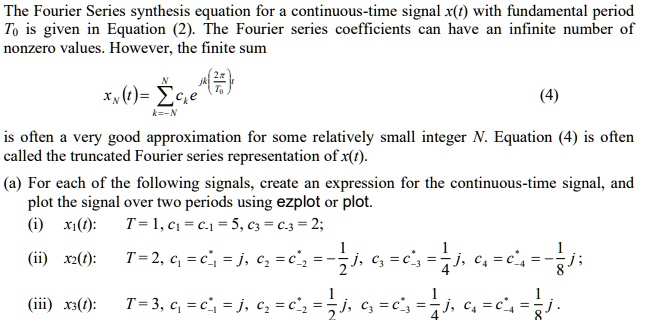
The Fourier Series synthesis equation for a continuous-time signal $x(t)$ with fundamental period
$T_0$ is given in Equation (2). The Fourier series coefficients can have an infinite number of
nonzero values. However, the finite sum
$$x_N(t) = \sum_{k=-N}^{N} c_k e^{j k \left(\frac{2 \pi}{T_0}\right) t}$$
(4)
is often a very good approximation for some relatively small integer $N$. Equation (4) is often
called the truncated Fourier series representation of $x(t)$.
(a) For each of the following signals, create an expression for the continuous-time signal, and
plot the signal over two periods using ezplot or plot.
(i) $x_1(t)$:
$T = 1$, $c_1 = c_{-1} = 5$, $c_3 = c_{-3} = 2$;
(ii) $x_2(t)$:
$T = 2$, $c_1 = c_{-1} = j$, $c_2 = c_{-2} = -\frac{1}{2}j$, $c_3 = c_{-3} = -\frac{1}{4}j$, $c_4 = c_{-4} = -\frac{1}{8}j$;
(iii) $x_3(t)$:
$T = 3$, $c_1 = c_{-1} = j$, $c_2 = c_{-2} = \frac{1}{2}j$, $c_3 = c_{-3} = \frac{1}{4}j$, $c_4 = c_{-4} = \frac{1}{8}j$.