Price
Level
SRAS1
LRAS
SRAS2
SRAS3
C
P5
B
K
P4
A
D
P3
QN = Natural Real GDP
P2
F
P1
E
0
Q1 Q2 QN Q4 Q5
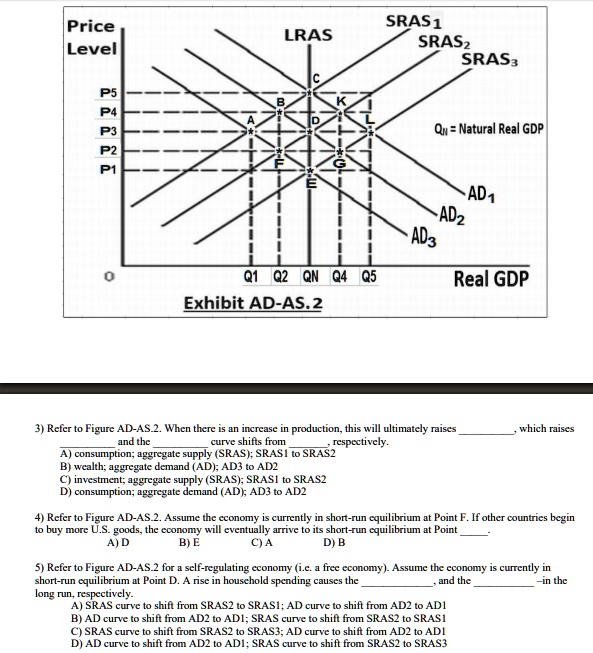
Exhibit AD-AS.2
AD1
AD2
AD3
Real GDP
3) Refer to Figure AD-AS.2. When there is an increase in production, this will ultimately raises
and the
curve shifts from
respectively.
which raises
A) consumption; aggregate supply (SRAS); SRAS1 to SRAS2
B) wealth; aggregate demand (AD); AD3 to AD2
C) investment; aggregate supply (SRAS); SRASI to SRAS2
D) consumption; aggregate demand (AD); AD3 to AD2
4) Refer to Figure AD-AS.2. Assume the economy is currently in short-run equilibrium at Point F. If other countries begin
to buy more U.S. goods, the economy will eventually arrive to its short-run equilibrium at Point
A) D
B) E
C) A
D) B
5) Refer to Figure AD-AS.2 for a self-regulating economy (i.e. a free economy). Assume the economy is currently in
short-run equilibrium at Point D. A rise in household spending causes the
and the
long run, respectively.
A) SRAS curve to shift from SRAS2 to SRAS1; AD curve to shift from AD2 to AD1
B) AD curve to shift from AD2 to AD1; SRAS curve to shift from SRAS2 to SRASI
C) SRAS curve to shift from SRAS2 to SRAS3; AD curve to shift from AD2 to AD1
D) AD curve to shift from AD2 to AD1; SRAS curve to shift from SRAS2 to SRAS3
-in the