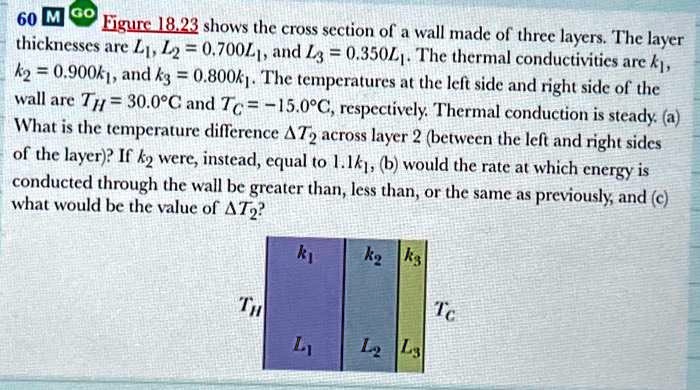
Figure 18.23 shows the cross section of a wall made of three layers. The layer thicknesses are $L_1$, $L_2 = 0.700L_1$, and $L_3 = 0.350L_1$. The thermal conductivities are $k_1$, $k_2 = 0.900k_1$, and $k_3 = 0.800k_1$. The temperatures at the left side and right side of the wall are $T_H = 30.0^\circ C$ and $T_C = -15.0^\circ C$, respectively. Thermal conduction is steady. (a) What is the temperature difference $\Delta T_2$ across layer 2 (between the left and right sides of the layer)? If $k_2$ were, instead, equal to $1.1k_1$, (b) would the rate at which energy is conducted through the wall be greater than, less than, or the same as previously, and (c) what would be the value of $\Delta T_2$?