Ace - AI Tutor
Ask Our Educators
Textbooks
My Library
Flashcards
Scribe - AI Notes
Notes & Exams
Download App
megan wright

megan w.

Divider

Questions asked

BEST MATCH

5 Multiple Choice 10 points The expected value of a discrete random variable is the most likely or highest probability value for the random variable. will always be one of the values x can take on, although it may not be the highest probability value for the random is the average value for the random variable over many repeats of the experiment. is the value it is expected to assume in the next trial. 6 Multiple Choice 10 points When dealing with the number of occurrences of an event over a specified interval of time or space, the appropriate probab

View Answer
divider
BEST MATCH

QUESTION 3 Solve the following initial and boundary problems. Check your answer by substituting and explain all the steps: axu_(x)+y^(2)u_(y)=0 u(x,1)=1+lnx. bu_(\times )-2u_(xy)+u_(yy)=0 u_(x)(x,0)=e^(x) and u_(y)(x,0)=cosx. Is this equation elliptic, parabolic or hyperbolic?

View Answer
divider
BEST MATCH

According to research, student with emotional disorders may function how many years below grade level in reading, math, writing, and spelling? 1 year 2 or more years 3 grades 4 months

View Answer
divider
BEST MATCH

Clinical improvement in leukemia patients has been observed when providing drugs that inhibit the enzyme ______. Multiple choice question. histone acetyltransferase DNA demethylase histone demethylase DNA methyltransferase histone methyltransferase

View Answer
divider
BEST MATCH

A can of soda at 79°F is placed in a refrigerator that maintains a constant temperature of 36°F. The temperature T of the soda t minutes after it is placed in the refrigerator is given by $T(t) = 36 + 43e^{-0.058t}$ (a) Find the temperature, to the nearest degree, of the soda 8 minutes after it is placed in the refrigerator. °F (b) When, to the nearest minute, will the temperature of the soda be 48°F? min

View Answer
divider
BEST MATCH

Explain the difference between book and market value of equity. Explain the difference between book and market value of equity.

View Answer
divider
BEST MATCH

Many governments may de-regulate product and labor markets or relax pollution controls so as to attract investments from multinational firms. Many governments may de-regulate product and labor markets or relax pollution controls so as to attract investments from multinational firms. True False

View Answer
divider
BEST MATCH

Given that f(x) = 4x - 2, find the following value: 3f(5) - 6f(2) = Give the answer as an integer or decimal rounded to the nearest.

View Answer
divider
BEST MATCH

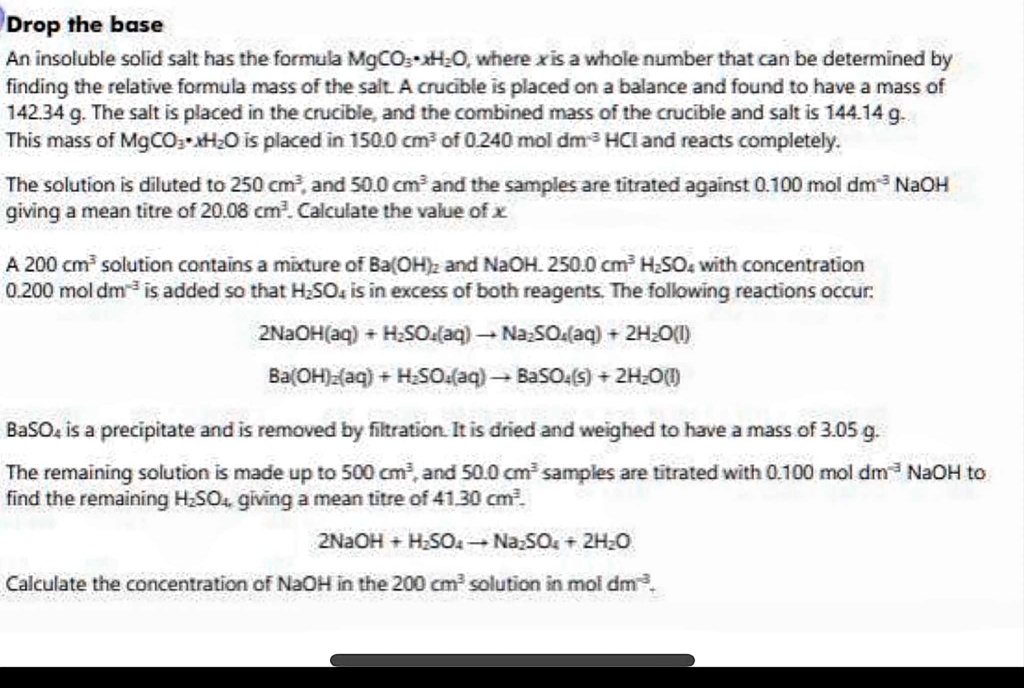
Texts: Drop the base. An insoluble solid salt has the formula MgCOₓ⋅H₂O, where x is a whole number that can be determined by finding the relative formula mass of the salt. A crucible is placed on a balance and found to have a mass of 142.34 g. The salt is placed in the crucible, and the combined mass of the crucible and salt is 144.14 g. This mass of MgCOₓ⋅H₂O is placed in 150.0 cm³ of 0.240 mol dm⁻³ HCl and reacts completely. The solution is diluted to 250 cm³ and 50.0 cm³, and the samples are titrated against 0.100 mol dm⁻³ NaOH, giving a mean titre of 20.08 cm³. Calculate the value of x. A 200 cm³ solution contains a mixture of Ba(OH)₂ and NaOH. 250.0 cm³ H₂SO₄ with concentration 0.200 mol dm⁻³ is added so that H₂SO₄ is in excess of both reagents. The following reactions occur: 2NaOH(aq) + H₂SO₄(aq) → Na₂SO₄(aq) + 2H₂O(l) Ba(OH)₂(aq) + H₂SO₄(aq) → BaSO₄(s) + 2H₂O BaSO₄ is a precipitate and is removed by filtration. It is dried and weighed to have a mass of 3.05 g. The remaining solution is made up to 500 cm³, and 50.0 cm³ samples are titrated with 0.100 mol dm⁻³ NaOH to find the remaining H₂SO₄, giving a mean titre of 41.30 cm³. 2NaOH + H₂SO₄ → Na₂SO₄ + 2H₂O Calculate the concentration of NaOH in the 200 cm³ solution in mol dm⁻³.
View Answer
divider
BEST MATCH

What is the rotational inertia of a uniform meter stick with mass 190 g about an axis perpendicular to the stick and located at the 29 cm mark? You can treat the stick as a thin rod.\ $I = 0.0237 \times kg \cdot m^2$ Hint: (1) Convert mass to kg and distance in cm to m; (2) Express axis location in distance from the center of mass of the ruler (not its end); (3) Use the parallel axis theorem for a thin rod with the axis moved off from the COM: $I_p = I_{com} + mh^2$

View Answer
divider