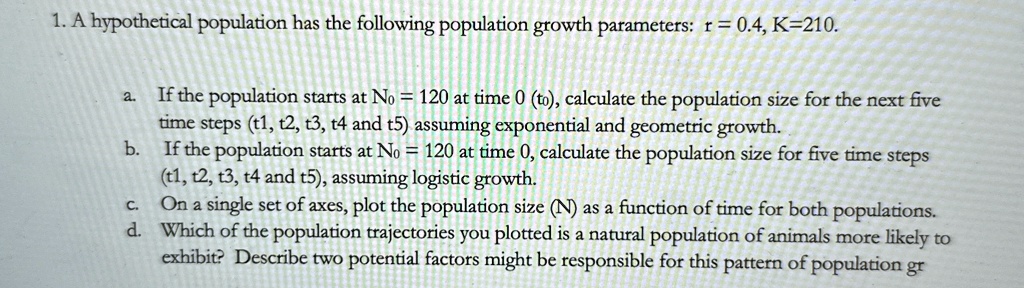
1. A hypothetical population has the following population growth parameters: r = 0.4, K=210.
a. If the population starts at $N_0$ = 120 at time 0 ($t_0$), calculate the population size for the next five
time steps ($t_1$, $t_2$, $t_3$, $t_4$ and $t_5$) assuming exponential and geometric growth.
b. If the population starts at $N_0$ = 120 at time 0, calculate the population size for five time steps
($t_1$, $t_2$, $t_3$, $t_4$ and $t_5$), assuming logistic growth.
c. On a single set of axes, plot the population size (N) as a function of time for both populations.
d. Which of the population trajectories you plotted is a natural population of animals more likely to
exhibit? Describe two potential factors might be responsible for this pattern of population gr