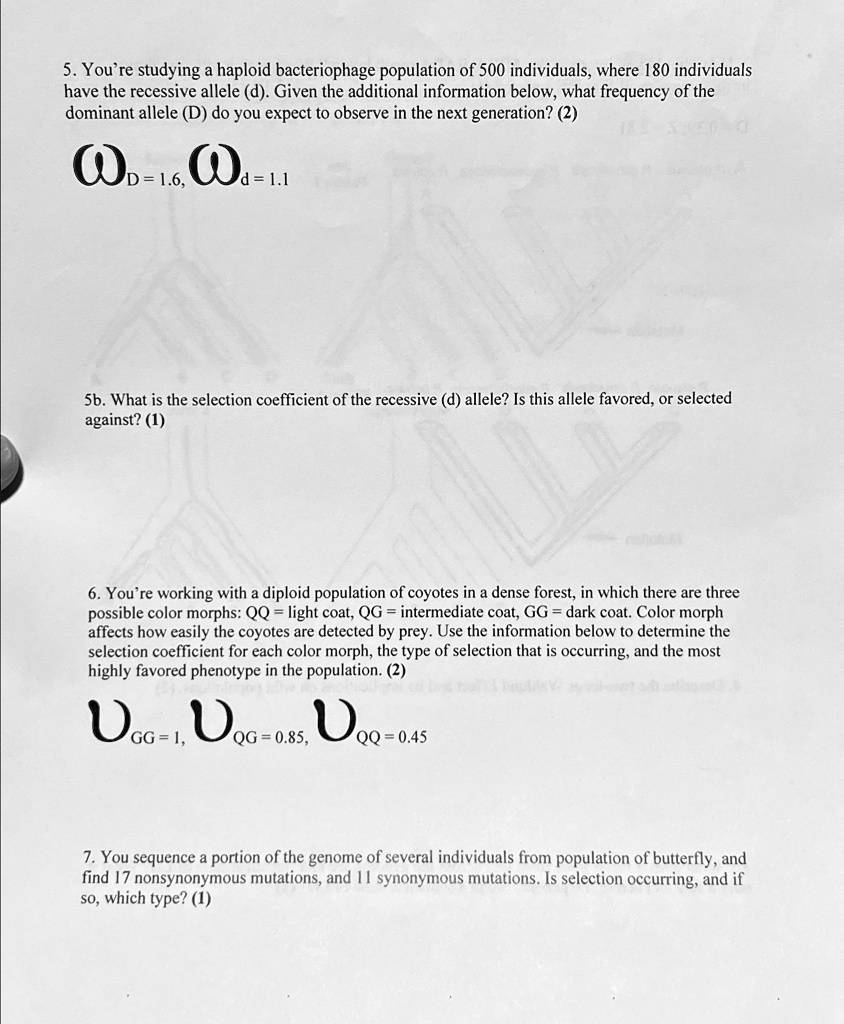
5. You're studying a haploid bacteriophage population of 500 individuals, where 180 individuals
have the recessive allele (d). Given the additional information below, what frequency of the
dominant allele (D) do you expect to observe in the next generation? (2)
$ \omega_D = 1.6, \omega_d = 1.1 $
5b. What is the selection coefficient of the recessive (d) allele? Is this allele favored, or selected
against? (1)
6. You're working with a diploid population of coyotes in a dense forest, in which there are three
possible color morphs: QQ = light coat, QG = intermediate coat, GG = dark coat. Color morph
affects how easily the coyotes are detected by prey. Use the information below to determine the
selection coefficient for each color morph, the type of selection that is occurring, and the most
highly favored phenotype in the population. (2)
$ \omega_{GG} = 1, \omega_{QG} = 0.85, \omega_{QQ} = 0.45 $
7. You sequence a portion of the genome of several individuals from population of butterfly, and
find 17 nonsynonymous mutations, and 11 synonymous mutations. Is selection occurring, and if
so, which type? (1)