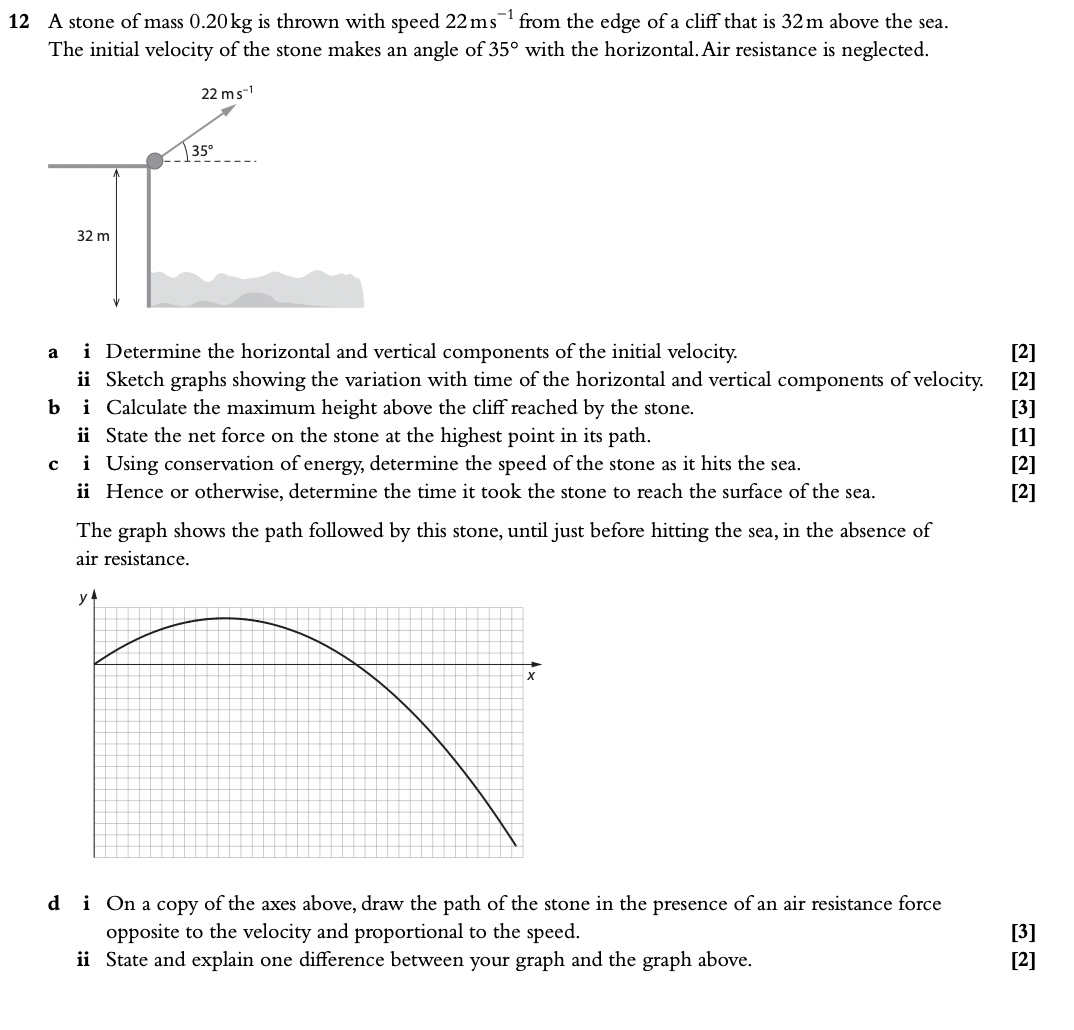
12 A stone of mass 0.20 kg is thrown with speed 22 m s-1 from the edge of a cliff that is 32 m above the sea. The initial velocity of the stone makes an angle of 35° with the horizontal. Air resistance is neglected.
a i Determine the horizontal and vertical components of the initial velocity. [2]
ii Sketch graphs showing the variation with time of the horizontal and vertical components of velocity. [2]
b i Calculate the maximum height above the cliff reached by the stone. [3]
ii State the net force on the stone at the highest point in its path. [1]
c i Using conservation of energy, determine the speed of the stone as it hits the sea. [2]
ii Hence or otherwise, determine the time it took the stone to reach the surface of the sea. [2]
The graph shows the path followed by this stone, until just before hitting the sea, in the absence of air resistance.
d i On a copy of the axes above, draw the path of the stone in the presence of an air resistance force opposite to the velocity and proportional to the speed. [3]
ii State and explain one difference between your graph and the graph above. [2]