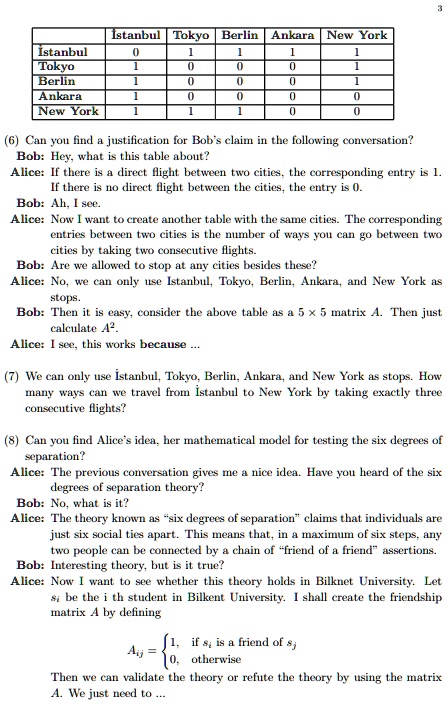
İstanbul Tokyo Berlin Ankara New York
İstanbul 0 1 1 1 1
Tokyo 1 0 0 0 1
Berlin 1 0 0 0 1
Ankara 1 0 0 0 0
New York 1 1 1 0 0
(6) Can you find a justification for Bob's claim in the following conversation?
Bob: Hey, what is this table about?
Alice: If there is a direct flight between two cities, the corresponding entry is 1.
If there is no direct flight between the cities, the entry is 0.
Bob: Ah, I see.
Alice: Now I want to create another table with the same cities. The corresponding
entries between two cities is the number of ways you can go between two
cities by taking two consecutive flights.
Bob: Are we allowed to stop at any cities besides these?
Alice: No, we can only use Istanbul, Tokyo, Berlin, Ankara, and New York as
stops.
Bob: Then it is easy, consider the above table as a 5 x 5 matrix A. Then just
calculate $A^2$.
Alice: I see, this works because ...
(7) We can only use İstanbul, Tokyo, Berlin, Ankara, and New York as stops. How
many ways can we travel from İstanbul to New York by taking exactly three
consecutive flights?
(8) Can you find Alice's idea, her mathematical model for testing the six degrees of
separation?
Alice: The previous conversation gives me a nice idea. Have you heard of the six
degrees of separation theory?
Bob: No, what is it?
Alice: The theory known as "six degrees of separation" claims that individuals are
just six social ties apart. This means that, in a maximum of six steps, any
two people can be connected by a chain of "friend of a friend" assertions.
Bob: Interesting theory, but is it true?
Alice: Now I want to see whether this theory holds in Bilknet University. Let
$s_i$ be the i th student in Bilkent University. I shall create the friendship
matrix A by defining
$A_{ij} = \begin{cases} 1, & \text{if } s_i \text{ is a friend of } s_j \\ 0, & \text{otherwise} \end{cases}$
Then we can validate the theory or refute the theory by using the matrix
A. We just need to ...