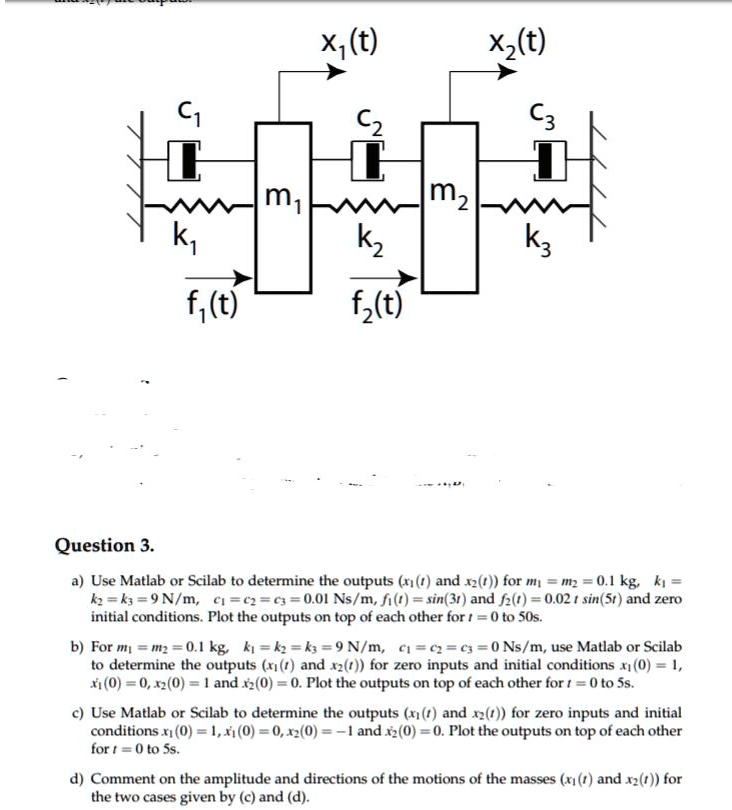
x?(t)
x?(t)
C?
C?
C?
m?
m?
k?
k?
k?
f?(t)
f?(t)
Question 3.
a) Use Matlab or Scilab to determine the outputs ($x_1(t)$ and $x_2(t)$) for $m_1 = m_2 = 0.1$ kg, $k_1 =$
k?=$k_3 = 9$ N/m, $c_1 = c_2 = c_3 = 0.01$ Ns/m, $f_1(t) = sin(3t)$ and $f_2(t) = 0.02t sin(5t)$ and zero
initial conditions. Plot the outputs on top of each other for $t = 0$ to 50s.
b) For $m_1 = m_2 = 0.1$ kg, $k_1 = k_2 = k_3 = 9$ N/m, $c_1 = c_2 = c_3 = 0$ Ns/m, use Matlab or Scilab
to determine the outputs ($x_1(t)$ and $x_2(t)$) for zero inputs and initial conditions $x_1(0) = 1$,
$x_1(0) = 0$, $x_2(0) = 1$ and $x_2(0) = 0$. Plot the outputs on top of each other for $t = 0$ to 5s.
c) Use Matlab or Scilab to determine the outputs ($x_1(t)$ and $x_2(t)$) for zero inputs and initial
conditions $x_1(0) = 1$, $x_1(0) = 0$, $x_2(0) = -1$ and $x_2(0) = 0$. Plot the outputs on top of each other
for $t = 0$ to 5s.
d) Comment on the amplitude and directions of the motions of the masses ($x_1(t)$ and $x_2(t)$) for
the two cases given by (c) and (d).