4.
A small city has only two decent restaurants. Chez Ordinaire and
Bistrot de Luxe. Each of these restaurants offers 3 grades of dinner, a light
plate, a house special, and the grand dinner. Everyone agrees that Bistrot
de Luxe has better food, but it costs more. The prices of the three types of
dinners at each restaurant are shown in the third column of the tables below.
The value that any diner places on each of these meals is given in the second
column.
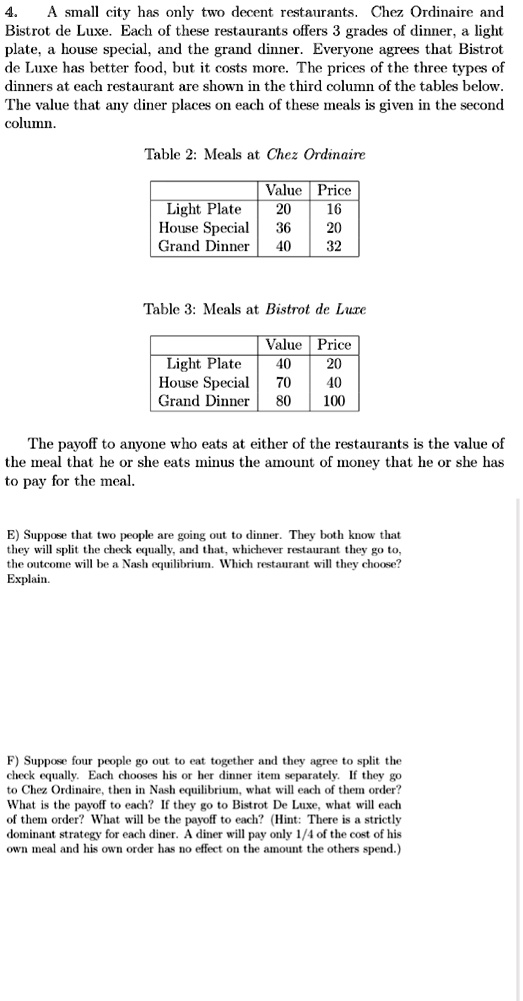
Table 2: Meals at Chez Ordinaire
Value Price
Light Plate 20 16
House Special 36 20
Grand Dinner 40 32
Table 3: Meals at Bistrot de Luxe
Value Price
Light Plate 40 20
House Special 70 40
Grand Dinner 80 100
The payoff to anyone who eats at either of the restaurants is the value of
the meal that he or she eats minus the amount of money that he or she has
to pay for the meal.
E) Suppose that two people are going out to dinner. They both know that
they will split the check equally, and that, whichever restaurant they go to,
the outcome will be a Nash equilibrium. Which restaurant will they choose?
Explain.
F) Suppose four people go out to eat together and they agree to split the
check equally. Each chooses his or her dinner item separately. If they go
to Chez Ordinaire, then in Nash equilibrium, what will each of them order?
What is the payoff to each? If they go to Bistrot De Luxe, what will each
of them order? What will be the payoff to each? (Hint: There is a strictly
dominant strategy for each diner. A diner will pay only 1/4 of the cost of his
own meal and his own order has no effect on the amount the others spend.)